Mud Cleaner Separation Efficiency: A Detailed Explanation
The separation efficiency of a mud cleaner is a measure of its effectiveness in performing its dual function: removing target fine solids while recovering valuable liquid and weight material. Unlike single-purpose equipment, its efficiency must be evaluated on multiple, sometimes competing, parameters.
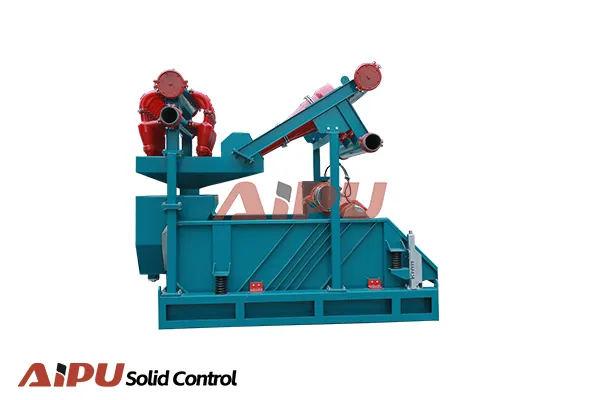
Core Efficiency Metrics
Efficiency is not a single number but a performance profile defined by:
-
Solids Removal Efficiency: The percentage of target solids (in a specific size range) removed from the feed stream.
-
Fluid/Barite Recovery Efficiency: The percentage of desirable liquid and weighting agent (barite) returned to the active mud system.
-
Drying Efficiency: The "dryness" of the discharged solids, measured as low liquid retention (e.g., % oil on cuttings for OBM).
The Efficiency Trade-Off Triangle
Mud cleaner operation involves balancing three competing goals, often visualized as a triangle:
-
High Solids Removal
-
High Fluid Recovery
-
Dry Discharge
Optimizing for one corner often compromises another. The ideal operating point is set by the economic and operational priorities of the specific drilling fluid system.
Factors Determining Separation Efficiency
1. Hydrocyclone Stage Efficiency
This stage determines what is presented to the screen.
-
Cut Point (d₅₀): The particle size at which a hydrocyclone has a 50% chance of reporting to either overflow or underflow. For a 4" cone, the d₅₀ might be ~25 microns.
-
Influenced by: Feed Pressure (higher pressure = finer cut point), Feed Density, Apex & Vortex Finder Diameters, and Fluid Viscosity.
-
-
Sharpness of Separation: How definitively particles above and below the cut point are separated. A "flat" curve indicates poor efficiency, with fines reporting to underflow and coarse particles to overflow.
-
Key Limitation: Hydrocyclones separate by mass and density, not just size. A large, low-density clay particle may report to the overflow, while a small, dense barite particle may report to the underflow.
2. Screening Stage Efficiency
This stage determines what is finally discarded.
-
Screen Mesh & Technology: A 200-mesh (74-micron) screen will theoretically retain all particles larger than 74 microns. However, 3D pyramid screens can trap smaller particles due to their shape, and screen blinding reduces effective opening size.
-
Fluid Capacity (Throughput): Measured in gallons per minute per square foot (GPM/ft²). Overloading the screen forces liquid and solids to exit with the discard, ruining efficiency.
-
Conveyance & Drying: Vibration G-force and pattern must be sufficient to move solids uphill for discharge while allowing sufficient dwell time for liquid to drain through.
3. System Design & Integration Efficiency
-
Feed Consistency: A steady, controlled feed from the charge pump is critical. Pulsing flow causes cyclones to "blink" and screens to overload intermittently.
-
Underflow Distribution: The cyclone underflow must be evenly distributed across the full screen width. Channeling leads to localized overloading.
-
Mass Balance: The system must be designed so that the volumetric flow rate of the cyclone underflow matches the drying and conveyance capacity of the screen.
Quantitative & Qualitative Efficiency Analysis
For a Weighted Mud System (Barite Recovery Focus):
-
Efficiency Goal: Maximize barite recovery while removing low-gravity solids (LGS).
-
Key Metric: Barite Recovery Ratio.
-
Measurement: Compare the density and solids content of the Feed vs. the Screen Throughs. A successful operation shows high-density screen throughs (rich in barite) and low-density, dry discarded solids.
-
Inefficiency Sign: Barite (identified by its high density and gamma ray signature) is present in the discard pile.
For an Unweighted/OBM System (Solids Removal & Drying Focus):
-
Efficiency Goal: Maximize solids dryness and minimize fluid loss.
-
Key Metric: Retained Liquid on Cuttings (%) and Particle Size Distribution (PSD) of the active mud.
-
Measurement:
-
Dryness: "Cookie test" – squeezing discharged solids should yield minimal liquid.
-
PSD: Laser particle size analysis of active mud should show a decline in the 15-74 micron fraction when the mud cleaner is operational.
-
Operational Levers for Optimizing Efficiency
-
Apex Adjustment (Most Critical Control):
-
Open Apex: Increases fluid recovery but sends more/wetter solids to screen, risking overload. Can reduce solids removal efficiency.
-
Closed Apex: Produces a drier underflow, improving screen drying but increases fluid loss to discard. Improves solids removal sharpness.
-
Optimum: A consistent "spray" discharge pattern.
-
-
Screen Mesh Selection:
-
Finer Mesh: Increases dryness and solids removal but reduces fluid handling capacity. Risk of blinding.
-
Coarser Mesh: Increases fluid recovery and throughput but allows more fine solids to pass back into the system.
-
-
Feed Density Management: Diluting the feed to the mud cleaner lowers viscosity, improving both cyclone separation and screen drainage efficiency, but increases total fluid volume.
-
Vibration Optimization: Adjusting G-force and angle to match the stickiness and volume of solids on the screen.
Conclusion: Defining "Good" Efficiency
A highly efficient mud cleaner operation is one that is tuned to its specific economic function:
-
In a weighted mud, it achieves >95% barite recovery while discharging dry, low-density fines.
-
In an unweighted mud, it removes >80% of the target abrasive silt (e.g., 20-50 micron) from its feed stream.
-
In an OBM system, it reduces Retained Oil on Cuttings (OOC) to below 5%, maximizing fluid return.
Ultimately, the true measure of efficiency is operational and economic outcome: reduced dilution costs, stable mud properties, lower disposal volumes, extended equipment life, and improved rate of penetration. The mud cleaner is efficient when it optimally resolves the fundamental trade-off between discarding the bad (drilled solids) and keeping the good (liquid and weight material).
Related Products