Shale Shaker Working Principle Explained: The Physics Behind Efficient Solids Control
The shale shaker is the unsung hero of drilling operations, yet its working principle is a fascinating blend of mechanical engineering and fluid dynamics. While many understand that a shale shaker "shakes mud," the precise physics governing how it separates tons of rock cuttings from valuable drilling fluid is often overlooked. This article provides a comprehensive explanation of the shale shaker working principle, from vibration mechanics to screen dynamics, and illustrates why this knowledge matters for drilling performance.
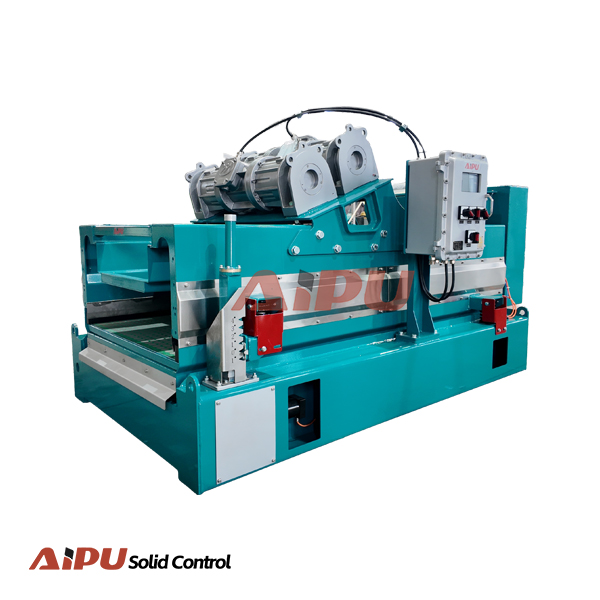
The Fundamental Physics: Vibration-Induced Stratification
At its core, the shale shaker working principle relies on forced vibration to overcome the cohesive forces binding solid particles to the liquid phase. When drilling mud—a complex non-Newtonian fluid—hits the vibrating screen deck, three key physical processes are triggered:
1. Inertial Separation
The shaker's motors generate a sinusoidal oscillatory motion. As the deck accelerates upward and forward, the solid particles (cuttings) experience a greater inertial resistance than the surrounding fluid due to their higher density. This differential acceleration causes the solids to separate from the liquid and move independently across the screen surface.
2. Rheological Stratification
The vibration energy disrupts the gel structure of the drilling mud, temporarily reducing its viscosity near the screen interface. This phenomenon, known as shear thinning, allows the liquid to flow more readily through the screen apertures while the solids remain on top. Without sufficient vibration, the mud's yield stress would prevent effective separation.
3. Particle Conveyance via Directed Force
The vibratory motors are mounted at a specific angle relative to the deck. This angled excitation produces a resultant force vector that propels solids in a controlled direction—typically uphill toward the discharge end. The angle of throw, combined with the deck slope, determines the transport velocity of cuttings and the retention time of fluid on the screen.
Understanding Vibration Modes: Linear vs. Elliptical Motion
The working principle is significantly influenced by the type of vibratory motion employed. Modern shale shakers utilize two primary motion patterns:

In linear motion shakers, the entire screen basket moves forward and upward in a straight line, then retracts. The solid particles are literally "thrown" forward with each cycle, landing further along the deck. This produces a rolling, tumbling action that exposes fresh mud surfaces to the screen, maximizing fluid throughput.
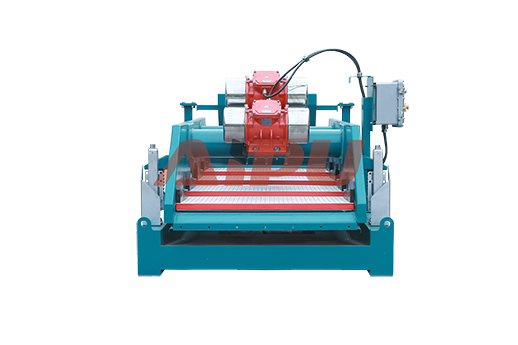
Balanced elliptical motion introduces a secondary, out-of-phase component that creates a slight circular motion at the feed end and a more elongated ellipse at the discharge end. This variable geometry action is exceptionally effective at handling "sticky" cuttings that tend to adhere to standard linear shakers. The Hunter-MGD Dual-motion Shale Shaker incorporates this advanced principle, allowing operators to switch between linear and elliptical modes as drilling conditions evolve—an internationally recognized design concept.
The Critical Role of G-Force and Amplitude
Two parameters are central to the working principle of any shale shaker:
-
G-Force: Expressed as multiples of gravitational acceleration (e.g., 6.5G), this measures the peak acceleration applied to the cuttings. Higher G-force (typically 6.0–7.5G in AIPU Hunter-MG shakers) increases the separation force on particles, helping to overcome the surface tension and viscosity of the mud.
-
Double Amplitude (Stroke): This is the peak-to-peak displacement of the deck, usually 5–6 mm. Larger strokes are better for coarse cuttings, while finer strokes suit high-frequency screening.
The relationship between G-force and frequency is described by the formula:
G = (Stroke × RPM²) / 1,800,000 (approximate)
AIPU Hunter-MG shakers are engineered with double amplitude of 5–6 mm and motor speeds of 1500/1800 rpm, yielding optimal G-forces that balance aggressive separation with structural durability and acceptable noise levels (≤85 db).
Screen Dynamics: The Gatekeeper of Separation
No explanation of the working principle is complete without addressing the screen panel. The screen is not a passive filter; it is an active participant in the separation process. The vibration energy must be transmitted through the screen frame to the mesh wires. Key factors include:
-
Screen Area: A larger screening surface provides more "open area" for fluid passage. The Hunter-MG4T, with 8.1 m² of screen area, can process up to 420 m³/h.
-
Screen Conductance: This measures how easily fluid passes through the mesh. Higher conductance reduces the "fluid head" on the screen, preventing loss of drilling fluid over the discharge end.
-
API Screen Number: Determines the cut point—the size at which particles are separated.
The adjustable deck angle (-1° to +5° in Hunter-MG models) is a crucial variable. A negative angle (downhill) increases fluid retention time for maximum recovery but slows solids transport. A positive angle (uphill) prioritizes solids removal in high-rate drilling.
Practical Application: AIPU Hunter-MG Series in Action
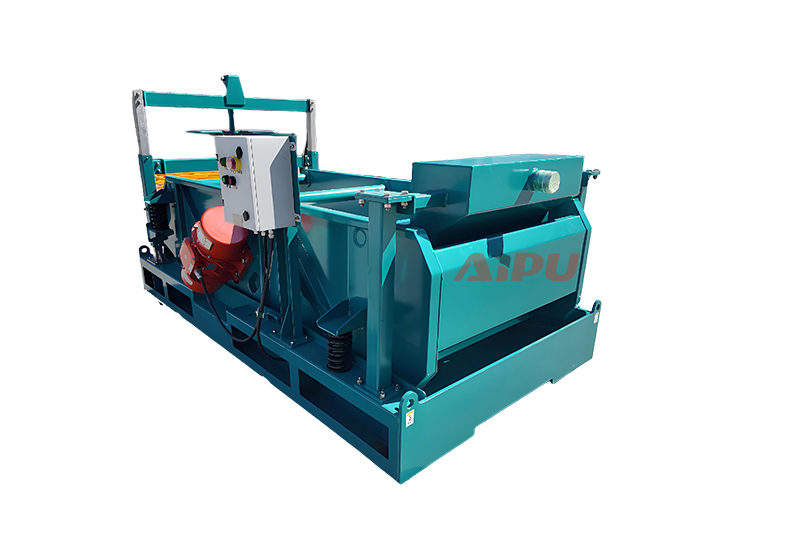
Translating principle into performance, the AIPU Hunter-MG shale shaker series embodies these engineering fundamentals:
-
Model Range: From the compact Hunter-Mini (1.35 m² screen area, 50 m³/h) to the high-capacity Hunter-MG4T (8.1 m², 420 m³/h), each model applies the same core working principle scaled to meet specific rig requirements.
-
Motor Flexibility: Options for Italvibras, Martin, or Oli motors ensure reliable vibration generation with customizable electrical systems (380V/50Hz or 460V/60Hz).
-
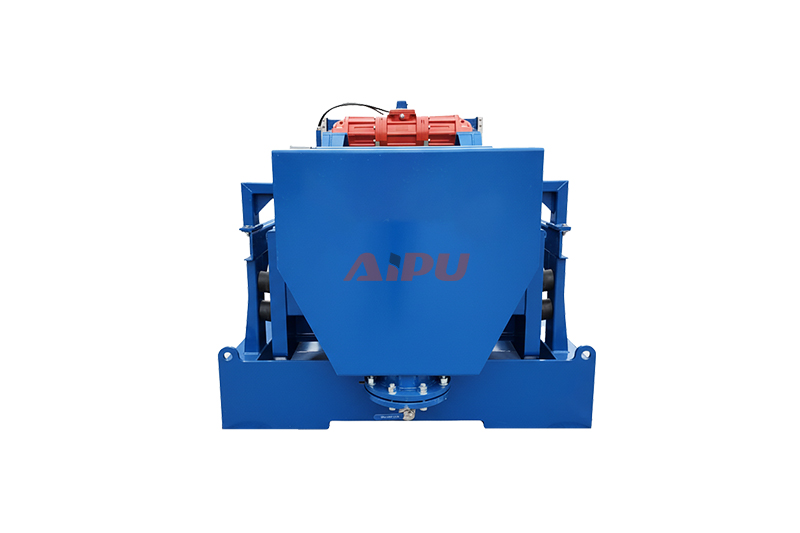
Robust Construction: The shaker basket is designed to withstand continuous dynamic loading, with strict sand-blasting and anti-corrosion coating procedures that extend service life in harsh environments.
For drilling programs that demand adaptability, the Hunter-MGD takes the working principle a step further by enabling on-the-fly switching between linear and elliptical motion. This dual-motion capability, achieved with just two specialized motors, allows the same shaker to handle abrasive sandstone in one section and sticky shale in the next—without mechanical modification.
Conclusion
The shale shaker working principle is a sophisticated orchestration of vibration mechanics, fluid rheology, and particle dynamics. By applying controlled G-forces through precision-engineered screens, the shale shaker achieves what gravity alone cannot: rapid, continuous separation of solids from a high-volume drilling fluid stream. Understanding these principles empowers drilling engineers to select the right shaker configuration—like the versatile AIPU Hunter-MG series—to optimize mud recovery, reduce waste, and protect downstream equipment. In the demanding economics of modern drilling, a well-tuned shale shaker is not just equipment; it is a strategic asset.
Related Products