How Shale Shaker Separates Solids: The Science Behind Primary Solids Control
In the demanding environment of oil and gas drilling, the ability to efficiently separate drilled cuttings from valuable drilling fluid is fundamental to operational success. At the forefront of this separation process stands the shale shaker—a device whose name suggests simplicity but whose function relies on a sophisticated interplay of physics, mechanical engineering, and materials science. Understanding how a shale shaker separates solids is essential for drilling engineers, rig crews, and anyone involved in optimizing drilling performance and reducing costs. This article provides a detailed, step-by-step exploration of the separation mechanism, from the moment mud-laden fluid hits the vibrating screen to the discharge of dry, conveyed cuttings.
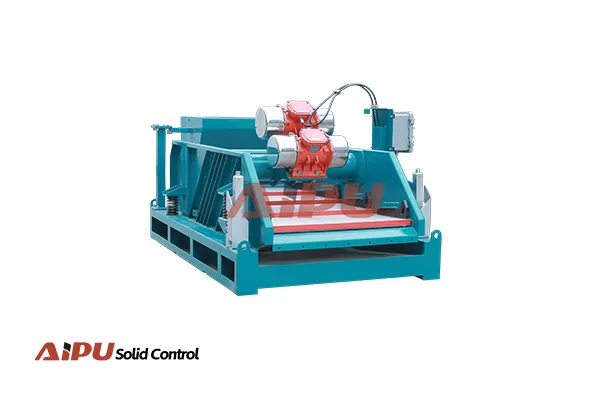
The Fundamental Principle: Vibration-Induced Separation
At its core, a shale shaker separates solids from liquids through the application of controlled, high-frequency vibration to a precision-meshed screening surface. Unlike a static sieve, which relies solely on gravity and quickly clogs, a shale shaker actively fluidizes the drilling mud, breaking down its gel structure and enabling rapid liquid throughput. The process can be broken down into four interconnected stages:
1. Even Distribution Across the Screen Surface
The separation process begins when returning drilling mud—carrying a wide distribution of rock fragments and formation fines—exits the wellbore flow line and enters the shaker's feed box or flow distributor. This component is designed to receive the high-velocity mud stream and spread it uniformly across the full width of the vibrating screen deck. Uniform distribution is critical: if mud is concentrated in one area, that section of the screen will be overwhelmed, leading to localized fluid pooling and reduced separation efficiency. A well-designed feed box, such as those integrated into the AIPU Hunter-MG series, ensures laminar, even flow across all screen panels.
2. Stratification: Organizing Solids and Liquids
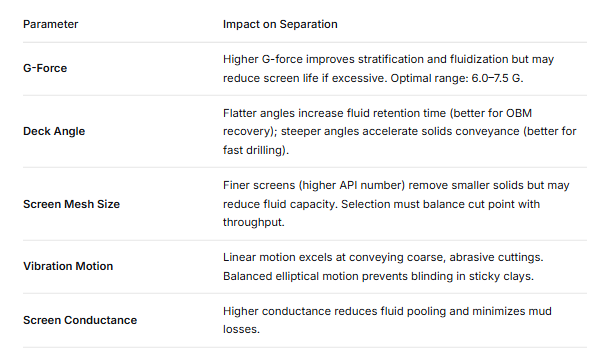
Once the mud spreads across the vibrating screen, the vibratory motors generate a sinusoidal oscillatory motion that accelerates the entire screen basket. This is where the physics of separation truly begins. The applied G-force—typically 6.0 to 7.5 G in modern shakers like the Hunter-MG series—causes the mud layer to undergo a phenomenon known as stratification.
Under the influence of high-frequency vibration, the denser, larger drill cuttings are driven downward toward the screen surface, while the lighter liquid phase and ultra-fine particles rise to the top. This layering effect is essential because it places the solids directly in contact with the filtering mesh, maximizing the probability of separation. Simultaneously, the vibration energy shear-thins the drilling mud at the screen interface, temporarily reducing its viscosity and yield stress. This allows the liquid to flow more readily through the screen apertures, overcoming the mud's natural resistance to flow.
3. Liquid Passage Through Precision Screens
The heart of the separation mechanism is the screen panel itself. Modern shale shakers use pretensioned screens conforming to API RP 13C standards, with precise mesh openings designed to target specific cut points—the particle size at which separation occurs. For primary shale shakers, the cut point is typically in the range of 74 to 100 microns (API 140 to API 200 screens).
As the stratified mud moves across the vibrating deck, the liquid phase, carrying particles smaller than the screen aperture, passes through the mesh openings under the combined influence of gravity and vibratory acceleration. This liquid underflow, now substantially free of coarse solids, is collected in a receiving tank or trough below the shaker and directed back to the active mud system for recirculation.
The efficiency of this liquid passage is governed by the screen's conductance—a measure of how easily fluid flows through the mesh. Higher conductance screens, combined with adequate G-force and proper deck angle, minimize the depth of the fluid pool on the screen, preventing valuable drilling fluid from being lost over the discharge end.
4. Conveyance and Discharge of Retained Solids
While liquid passes through the screen, the retained solids—those larger than the screen's cut point—must be continuously removed to prevent accumulation and screen blinding. This is accomplished through the directional component of the vibration vector.
In a linear motion shaker, the vibratory motors are mounted at a specific angle (typically 45° to 60° relative to the deck) and rotate in opposite directions. This generates a straight-line force that propels the solids along the screen surface toward the discharge end. The basket itself is installed at an adjustable incline (usually a positive, uphill angle), which works in concert with the vibration vector to control the conveyance velocity of the cuttings.
As the shaker vibrates, the solids are literally "thrown" forward in a series of micro-trajectories. With each oscillation, they land further along the deck, creating a continuous, tumbling motion that exposes fresh cuttings surfaces and prevents the formation of a thick, impermeable solids bed. Eventually, the separated cuttings reach the discharge chute and are ejected into a collection box, screw conveyor, or secondary drying shaker for further processing.
For formations containing sticky, reactive clays, linear motion alone can sometimes be insufficient, as the clay tends to adhere to the screen wires, causing blinding. In these conditions, balanced elliptical motion offers a superior separation mechanism. By altering the phase relationship between the two vibratory motors, the motion path becomes elliptical, with the major axis changing orientation throughout the cycle. This elliptical action creates a "wiping" or "scrubbing" effect that prevents clay from adhering to the screen, maintaining open mesh area and consistent separation efficiency.
Factors Influencing Separation Efficiency
Several operational parameters directly impact how effectively a shale shaker separates solids:
AIPU Hunter-MG Series: Precision Engineering for Superior Solids Separation
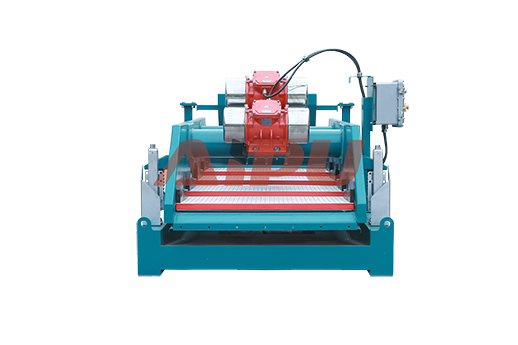
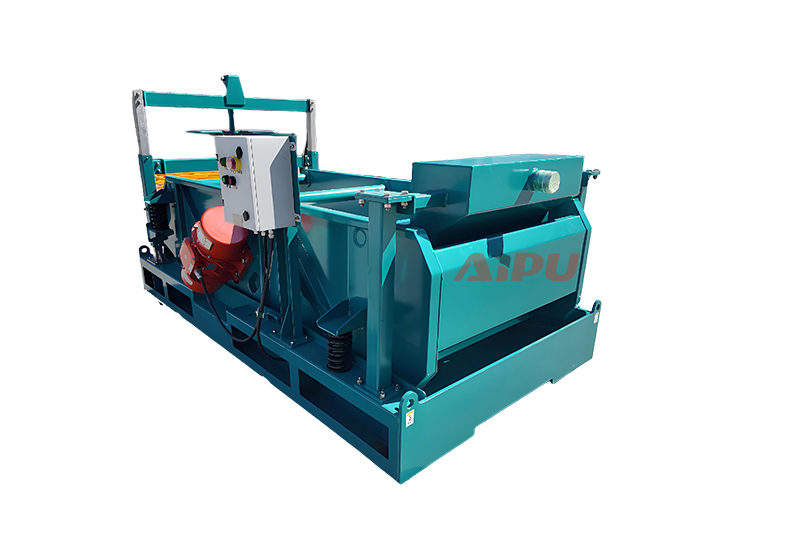
The principles described above are not merely theoretical—they are embodied in the design and operation of the AIPU Hunter-MG series shale shaker. Manufactured by Aipu Solid Control Co., Ltd, a company with over two decades of specialized industry expertise, the Hunter-MG lineup is engineered to deliver reliable, high-efficiency solids separation across a wide spectrum of drilling conditions.
How Hunter-MG Shakers Optimize Each Stage of Separation
1. Uniform Distribution
Hunter-MG shakers feature an optimized feed box design that promotes laminar flow distribution across the entire screen width. This ensures that every square centimeter of screen area is utilized effectively, maximizing the shaker's rated capacity.
2. Powerful, Controlled Stratification
Equipped with premium vibratory motors from globally trusted brands such as Italvibras, Martin, and Oli, Hunter-MG shakers generate consistent G-forces in the optimal 6.0–7.0 G range. This provides the energy necessary to fluidize heavy drilling mud and stratify solids without subjecting the screen panels or basket to excessive mechanical stress. Double amplitudes of 5–6 mm are standard, contributing to effective particle agitation.
3. Precision Screening with Flexible Options
Hunter-MG shakers accommodate a wide range of steel-framed and composite-framed API screen panels. Composite screens offer lighter weight and superior corrosion resistance, while steel frames provide rugged durability. Operators can select the precise mesh size required to achieve the desired cut point for the specific formation being drilled.
4. Optimized Solids Conveyance and Discharge
The adjustable deck angle—ranging from -1° to +5° across most Hunter-MG models—empowers drilling crews to fine-tune the balance between fluid retention and solids transport in real time. When drilling expensive oil-based mud, a flatter angle maximizes base fluid recovery. During fast, unconsolidated surface intervals, a steeper angle rapidly clears the deck of voluminous cuttings.
5. Advanced Motion Technology: The Hunter-MGD
For operations that encounter highly variable lithology, the Hunter-MGD dual-motion shaker represents the pinnacle of separation flexibility. This model utilizes specialized motors to achieve both balanced elliptical and linear vibration modes using only two motors. The operator can switch between modes on the fly, selecting linear motion for abrasive sandstone sections and balanced elliptical motion for sticky, reactive clay intervals. This adaptability ensures that the shaker's separation mechanism remains optimally matched to downhole conditions throughout the well.
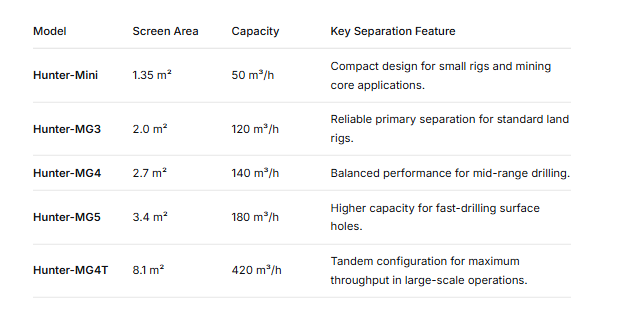
Hunter-MG Series Models and Separation Capacity
Conclusion
The question of how a shale shaker separates solids finds its answer in a carefully orchestrated sequence of physical processes: uniform distribution, vibratory stratification, precision screening, and directional conveyance. Each stage depends on the precise application of mechanical energy and the selection of appropriate operating parameters. When executed correctly, this process removes the bulk of harmful drill cuttings from the circulating mud system, protecting downstream equipment, preserving fluid properties, and reducing overall drilling costs.
The AIPU Hunter-MG series exemplifies how advanced engineering translates these fundamental principles into reliable, high-performance equipment. With features like adjustable deck angles, premium vibratory motors, flexible screen options, and dual-motion capability, Hunter-MG shakers provide drilling contractors with the tools they need to achieve superior solids control in even the most challenging wells.
Related Products