How Deck Angle Affects Shale Shaker Efficiency: Mastering Fluid Retention and Solids Conveyance
In the pursuit of optimal solids control performance, drilling engineers and rig crews have a powerful yet often underutilized tool at their disposal: the shale shaker deck angle adjustment. While factors such as screen mesh size, G-force, and vibration motion are widely recognized as critical to shaker performance, the angle of the screen deck is a variable that can be fine-tuned in real time to match changing drilling conditions. Understanding how deck angle affects shale shaker efficiency is essential for maximizing drilling fluid recovery, minimizing waste, and protecting downstream equipment. This article provides a comprehensive exploration of deck angle dynamics, practical guidelines for angle selection, and highlights how advanced shaker designs like the AIPU Hunter-MG series empower operators with precise angle control.
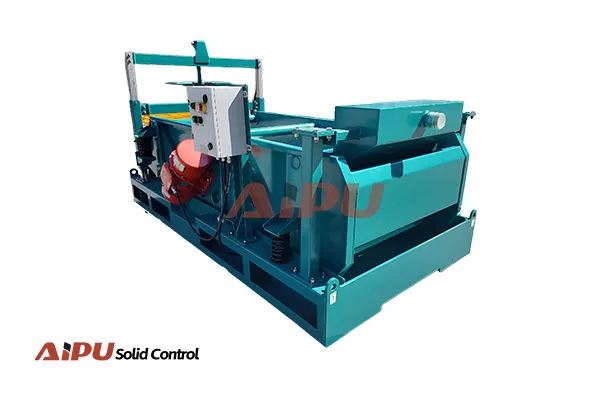
What Is Deck Angle on a Shale Shaker?
The deck angle (also called basket angle or screen inclination) is the slope of the vibrating screen basket relative to the horizontal plane. It is typically expressed in degrees, with positive values indicating an uphill slope toward the discharge end and negative values indicating a downhill slope.
Most modern shale shakers offer an adjustable deck angle range of approximately -1° to +5°, though specific models may vary. This adjustability is achieved through manual mechanisms (such as hand-crank jacks or pin-and-hole systems) or hydraulic actuation on larger, more sophisticated units.
The deck angle is not merely a set-and-forget parameter; it is a dynamic control that directly influences two competing objectives in the separation process:
-
Fluid Retention Time: How long the drilling mud remains on the screen surface, allowing liquid to pass through the mesh.
-
Solids Conveyance Velocity: How quickly the separated cuttings are transported across the deck and discharged.
The Physics: How Deck Angle Influences Separation Dynamics
The relationship between deck angle and shaker efficiency is governed by fundamental physics. Gravity acts on the mud pool and cuttings, while the vibratory motors provide a directional acceleration vector. The deck angle modifies the effective component of gravity along the screen surface and alters the relative angle between the vibration vector and the deck.
1. Effect on Fluid Retention and Liquid Throughput
When the deck angle is flatter (lower positive angle or negative angle) , gravity provides less assistance in moving the mud pool toward the discharge end. The fluid remains on the screen surface for a longer period. This increased retention time offers several efficiency benefits:
-
Higher Liquid Recovery: More time is available for the liquid phase to drain through the screen openings, reducing the fluid content of discharged cuttings.
-
Better Fine Solids Separation: Extended contact with the screen allows more fine particles to pass through, improving the cut point efficiency.
-
Ideal for Expensive Fluid Systems: In oil-based mud (OBM) or synthetic-based mud (SBM) operations, maximizing base fluid recovery is a primary economic driver. A flatter deck angle is preferred to minimize fluid losses.
However, an excessively flat or negative angle carries risks:
-
Reduced Solids Conveyance: Cuttings move very slowly, potentially accumulating on the deck and creating a thick solids bed that impedes fluid flow.
-
Increased Risk of Flooding: If the shaker cannot convey solids fast enough to match the incoming volume, the mud pool deepens and may overflow the sides or discharge end.
2. Effect on Solids Conveyance and Capacity
When the deck angle is steeper (higher positive angle) , gravity works in concert with the vibratory conveyance vector to accelerate the movement of solids toward the discharge. This provides several operational advantages:
-
Higher Throughput Capacity: The shaker can process larger volumes of cuttings without accumulating a thick solids bed, making it suitable for fast-drilling surface intervals.
-
Reduced Risk of Overloading: Rapid solids removal prevents the basket from becoming overloaded during high-rate drilling or when encountering unconsolidated formations.
-
Better Handling of Coarse, Heavy Cuttings: Large, dense particles that might otherwise stall on a flat deck are efficiently conveyed off the screen.
The trade-offs of a steeper angle include:
-
Reduced Fluid Retention Time: The mud pool moves faster across the screen, providing less time for liquid drainage. This can result in wetter cuttings and increased fluid loss over the discharge end.
-
Potential for Reduced Cut Point Efficiency: Shorter contact time may allow some near-cut-point particles to be discharged without passing through the screen.
Optimal Deck Angle Selection for Different Drilling Scenarios
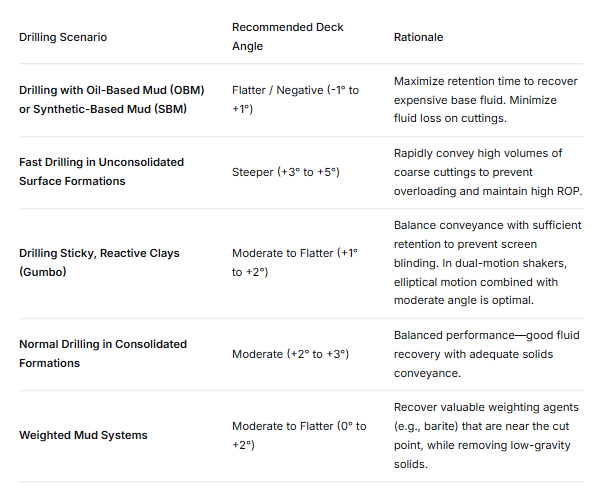
There is no single "best" deck angle for all conditions. Efficiency is maximized when the angle is matched to the specific drilling environment and operational objectives. The following table provides practical guidance:
The Role of Deck Angle in Combination with Other Parameters
Deck angle does not operate in isolation. Its effect on efficiency is modulated by other shaker settings:
-
G-Force and Vibration Motion: Higher G-forces improve fluidization, allowing a steeper angle to be used without sacrificing fluid recovery. Balanced elliptical motion, with its anti-blinding properties, permits flatter angles in sticky formations.
-
Screen Mesh Size: Finer screens reduce fluid throughput. When using fine screens, a flatter deck angle is often necessary to provide adequate retention time for liquid passage.
-
Mud Rheology: High-viscosity muds drain slowly and benefit from flatter angles and longer retention times.
AIPU Hunter-MG Series: Precision Deck Angle Control for Maximum Efficiency
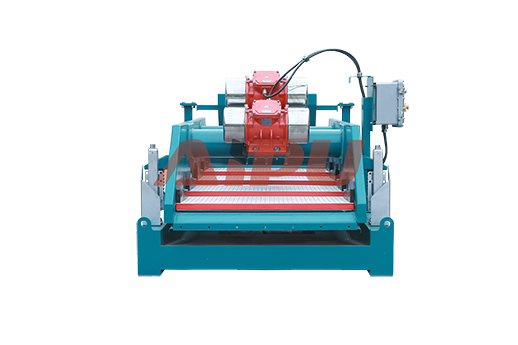
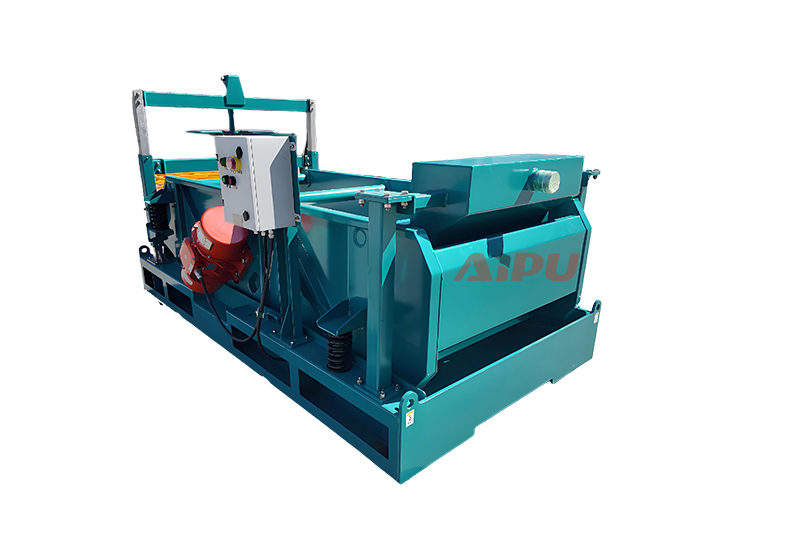
Recognizing the critical influence of deck angle on shaker performance, the AIPU Hunter-MG series shale shaker is engineered with adjustable deck angle capability across virtually all models. Manufactured by Aipu Solid Control Co., Ltd, a company with over 20 years of specialized solids control expertise, the Hunter-MG lineup empowers drilling crews to optimize this key parameter in real time, adapting to changing downhole conditions without interrupting the drilling process.
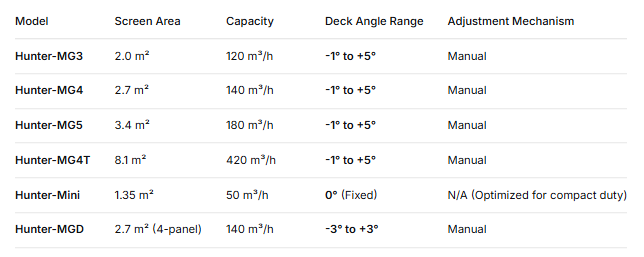
Note: Manual adjustment is typically accomplished via a hand-crank jack system or pin-and-hole mechanism, allowing quick changes without specialized tools.
How Hunter-MG's Adjustable Deck Angle Enhances Efficiency
1. Real-Time Optimization for Fluid Recovery
When drilling with expensive OBM or SBM, the ability to dial the deck angle down to -1° (or -3° on the Hunter-MGD) maximizes fluid retention time. This ensures that every possible liter of base oil or synthetic fluid is recovered, directly reducing operational costs and minimizing waste disposal volumes.
2. Rapid Response to Fast Drilling Intervals
During high-ROP surface hole drilling, operators can quickly increase the deck angle to +5° to accelerate cuttings conveyance. This prevents the shaker from becoming a bottleneck, allowing the rig to maintain maximum drilling speed without risking shaker overload or mud losses over the sides.
3. Optimized Performance in Variable Formations with the Hunter-MGD
The Hunter-MGD dual-motion shaker offers an extended deck angle range of -3° to +3° , providing even greater flexibility when combined with its selectable vibration modes. In sticky clay sections, a moderate angle combined with balanced elliptical motion prevents screen blinding while maintaining adequate fluid recovery. In abrasive sandstone sections, switching to linear motion and adjusting the angle upward ensures rapid solids clearance.
4. Consistent Performance Across All Screen Configurations
Hunter-MG shakers accommodate a wide range of API screen panels—both steel-framed and composite-framed. The adjustable deck angle allows operators to fine-tune the shaker's response to compensate for the flow characteristics of different screen meshes. Finer screens, which inherently reduce fluid capacity, can be used effectively by flattening the deck angle to increase retention time.
Additional Hunter-MG Features That Complement Deck Angle Adjustment
-
Premium Vibratory Motors: Equipped with motors from Italvibras, Martin, and Oli, Hunter-MG shakers deliver consistent G-forces (6.0–7.0G) and double amplitudes (5–6 mm). This reliable vibration energy ensures that changes in deck angle translate directly into predictable changes in solids conveyance and fluid recovery.
-
Robust Basket Construction: The heavy-duty welded basket is designed to maintain structural integrity across the full range of deck angles, even under the high dynamic loads of continuous operation.
-
Noise Control: Even at steeper angles and maximum throughput, Hunter-MG shakers operate at or below 85 db, contributing to a safer, more comfortable rig floor environment.
-
Customizable Electrical Systems: Shakers can be configured for 380V/50Hz or 460V/60Hz power supplies, with optional ATEX and IECEX certifications for hazardous area operation.
Practical Guidelines for Deck Angle Adjustment in the Field
To maximize shaker efficiency through deck angle control, rig crews should follow these best practices:
-
Monitor the Fluid Pool Depth: A pool that is too deep indicates insufficient conveyance or excessive fluid volume. Increase the deck angle slightly or check for screen blinding. A pool that is too shallow or dry near the discharge may indicate excessive angle or low fluid volume.
-
Observe Cuttings Discharge: Wet, sloppy cuttings suggest that fluid retention time is too short. Flatten the deck angle to improve drainage. Dry, slow-moving cuttings may indicate the angle is too flat, potentially leading to solids accumulation.
-
Adjust Incrementally: Make small adjustments (0.5° to 1°) and allow the shaker to stabilize for several minutes before evaluating the effect. Drastic changes can disrupt the equilibrium of the mud system.
-
Consider the Entire System: Changes in deck angle affect the fluid and solids balance of the entire solids control train. Communicate angle adjustments to the mud engineer and downstream equipment operators.
Conclusion
The deck angle of a shale shaker is a powerful, real-time control variable that directly influences fluid retention, solids conveyance, and overall separation efficiency. Understanding how deck angle affects shale shaker efficiency enables drilling crews to tailor shaker performance to the specific demands of each formation, mud type, and drilling phase. The AIPU Hunter-MG series, with its precise adjustable deck angle capability across a wide range of models, provides operators with the flexibility needed to optimize primary solids control in even the most challenging wells. By mastering deck angle adjustment, rig crews can significantly enhance drilling fluid recovery, reduce waste, protect downstream equipment, and ultimately lower the total cost of well construction.
Related Products