What Is a Shearing Pump? Complete Technical Guide for Drilling Fluid Systems
In modern oil and gas drilling, the performance of drilling fluid directly affects safety, efficiency, and operating cost. While shale shakers, desanders, and centrifuges are well‑known, one piece of equipment is often misunderstood or overlooked: the shearing pump. This comprehensive guide explains exactly what a shearing pump is, how it works, why it is essential, and why AIPU Solid Control delivers the most reliable shearing pumps for the global drilling industry.
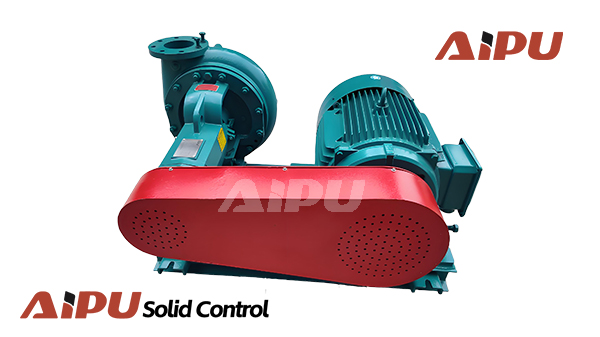
1. What Is a Shearing Pump? – Definition
A shearing pump is a specially designed centrifugal pump that generates extremely high shear forces to mechanically break down, hydrate, and disperse polymers, clays, and other additives used in drilling fluids. Unlike ordinary centrifugal pumps that only transfer fluid, a shearing pump actively modifies the physical properties of the mud – turning partially mixed, lumpy fluid into a smooth, fully functional drilling fluid.
2. Why Do Drilling Operations Need a Shearing Pump?
Drilling fluids contain high‑molecular‑weight polymers (e.g., polyacrylamide, PAC, CMC) and clays (bentonite) that are difficult to hydrate. When added directly to a mud system without sufficient shear, these materials form “fish eyes” – small, gelatinous, unhydrated particles that:
-
Clog shale shaker screens, causing mud loss and costly downtime.
-
Waste expensive chemicals, with material losses of 15–30%.
-
Damage formation permeability, reducing oil and gas production.
-
Increase overall drilling fluid costs.
A shearing pump solves these problems by providing intense mechanical energy to break down and hydrate polymers quickly and completely. The result: up to 30% savings in bentonite, 15% savings in polymers, and complete elimination of fish eyes.
3. How Does a Shearing Pump Work? – Working Principle
The shearing pump is based on a modified centrifugal pump principle but incorporates critical internal features that create high shear.
Step 1 – High‑Speed Rotation
A powerful electric motor (typically 37–55 kW in AIPU models) drives a specially designed impeller at high speed – usually 1900–2200 RPM, significantly faster than standard centrifugal pumps (1450–1750 RPM).
Step 2 – Dual‑Path Fluid Flow
Inside the pump, the fluid is divided into two paths:
-
Primary path: Fluid passes directly through the impeller and out the discharge.
-
Secondary path: Fluid enters a collection chamber and is forced through multiple small nozzles (e.g., 44 nozzles) at high velocity, impacting a rotating shear plate.
Step 3 – Intense Shearing Action
As the high‑velocity jets hit the rotating shear plate, polymer molecules and clay particles are torn apart, dispersed, and hydrated. The fluid passes through this shear zone repeatedly, achieving a hydration time reduction from 4 hours to just 15 minutes, with shear efficiency exceeding 95%.
Step 4 – Uniform Discharge
The fully mixed, homogenous mud exits the pump and can be sent directly to the mud mixing hopper or mud tank for immediate use.
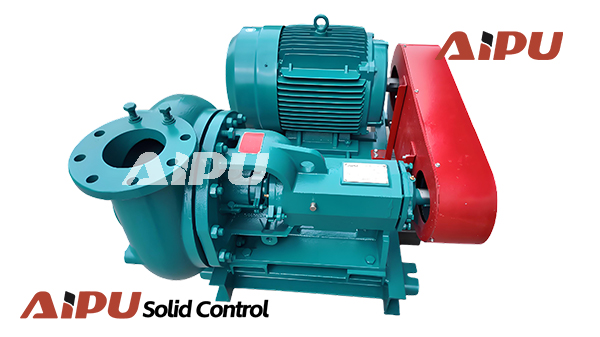
4. Shearing Pump vs. Centrifugal Pump: Key Differences
Many people confuse shearing pumps with standard centrifugal pumps. The table below clearly distinguishes them:
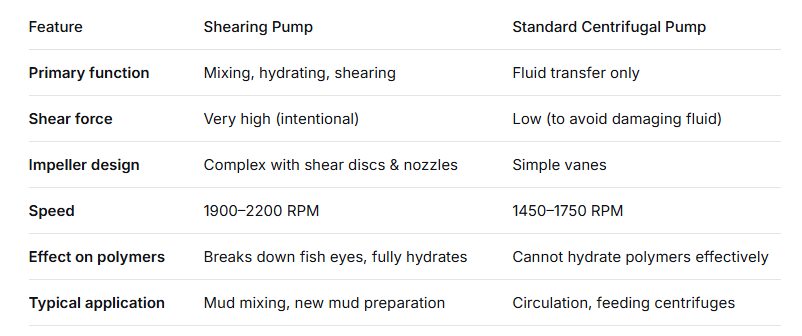
In short: use a centrifugal pump to move mud; use a shearing pump to prepare mud.
5. Key Applications of Shearing Pumps in Drilling
Shearing pumps are essential in the following scenarios:
-
New mud preparation: When mixing bentonite, water, and polymers for a fresh mud system, a shearing pump ensures fast, uniform hydration.
-
Polymer hydration: Polymers require high shear to unfold their molecular chains. The shearing pump achieves this in minutes.
-
Weight‑up operations: When adding barite or other weighting agents, a shearing pump helps maintain homogeneous viscosity.
-
Waste mud treatment: Shearing pumps can rehydrate and recondition waste mud for reuse, reducing disposal costs.
-
Chemical additive mixing: Liquid or powder additives are instantly dispersed without forming lumps.
6. Why AIPU Shearing Pumps Are the Industry’s Top Choice
When searching for a reliable shearing pump, AIPU Solid Control stands out as a global leader with over 20 years of industry experience. AIPU has delivered equipment to more than 30 countries and accumulated over 300 system‑equivalent shipments.
AIPU APJQB Series Shearing Pump – Technical Specifications

Data sourced from AIPU official product documentation.
Core Advantages of AIPU Shearing Pumps
✅ Extreme shear efficiency – Achieves >95% shear efficiency and reduces polymer hydration time from hours to just 15 minutes.
✅ Significant cost savings – Saves >30% bentonite and >15% polymer compared to conventional mixing methods.
✅ Robust and durable – Hardened 440C stainless steel rotor and tandem mechanical seals provide up to 10,000 hours MTBF (Mean Time Between Failures).
✅ API compliant – Designed, manufactured, and tested according to API 13A standards.
✅ Flexible customization – AIPU offers:
-
Multiple motor brands and voltages (380V/50Hz, 460V/60Hz, etc.)
-
Explosion‑proof certifications: ATEX, IECEX, UL
-
Material upgrades: 316L stainless steel or 2205 duplex steel for H₂S service
-
Custom surface colors (any RAL code)
✅ Global support – AIPU provides full technical documentation, installation guidance, and after‑sales service worldwide.
7. How to Select the Right Shearing Pump for Your Rig
When choosing a shearing pump, consider these factors:
-
Flow rate required: Small rigs may need 50–80 m³/h; large rigs may need 150–200 m³/h. AIPU APJQB series covers 100–155 m³/h.
-
Mud type: Water‑based mud (WBM), oil‑based mud (OBM), or synthetic‑based mud (SBM). AIPU pumps handle all types.
-
Power availability: Ensure your rig’s electrical system matches the pump’s motor (customizable).
-
Hazardous area requirements: For Zone 1 or Zone 2 areas, choose ATEX/IECEX certified pumps – available from AIPU.
-
Space constraints: AIPU’s compact design (1150×1100×1250 mm for APJQB6535) fits most skid‑mounted systems.
8. Common Misconceptions About Shearing Pumps
❌ “A standard centrifugal pump can do the same job.”
False. A centrifugal pump lacks the internal shear mechanism and will leave fish eyes undissolved.
❌ “Shearing pumps are only for water‑based mud.”
Incorrect. AIPU shearing pumps are equally effective with oil‑based and synthetic‑based muds.
❌ “Higher speed always means better shearing.”
Not exactly. Proper shear comes from the combination of speed, nozzle design, and shear plate geometry – precisely engineered in AIPU pumps.
9. Conclusion: Invest in a High‑Performance Shearing Pump
A shearing pump is not an optional accessory – it is a critical component of any modern solids control system. It transforms raw, poorly mixed mud into a smooth, high‑performance drilling fluid, saving materials, reducing downtime, and protecting the reservoir.
AIPU Solid Control has been designing and manufacturing shearing pumps for over two decades. With robust construction, exceptional shear efficiency, and flexible customization options, AIPU’s APJQB series shearing pumps are the smart choice for drilling contractors worldwide.
If you want to cut bentonite usage by 30%, eliminate fish eyes, and reduce polymer costs by 15%, choose AIPU – your partner in solids control excellence.
Related Products