What Is a Jet Mixing Device? Complete Guide to Drilling Fluid Mixing Technology
In the solids control system of oil and gas drilling, proper mixing of drilling fluid is just as important as separating solids. When you need to add barite to increase mud weight, or bentonite to improve viscosity, or polymers to control fluid loss, you need a device that can quickly and efficiently blend these materials into the base fluid. That device is the jet mixing device (also called a jet hopper or mud mixing hopper). This article explains what a jet mixing device is, how it works, where it is used, and why AIPU Solid Control manufactures some of the most reliable jet mixing systems for the global drilling industry.
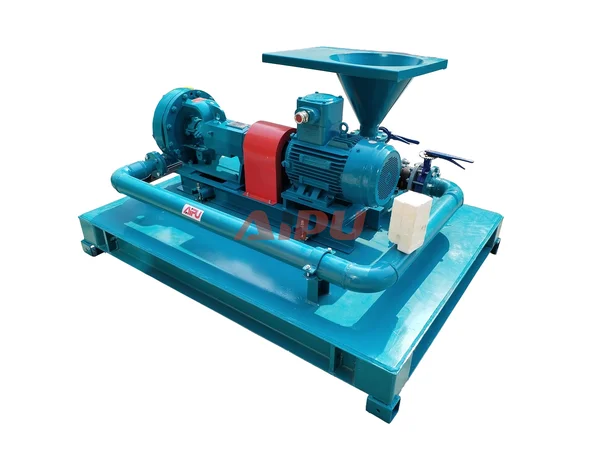
1. What Is a Jet Mixing Device? – Definition
A jet mixing device (jet mixer or jet hopper) is a specialized piece of equipment used to rapidly add and blend dry or liquid additives into drilling fluid. It uses the Venturi principle to create a vacuum that sucks powdered materials (such as barite, bentonite, or gel) into a high-velocity fluid stream, where they are mixed and wetted before being discharged into the mud tank.
In simple terms: a jet mixing device is like a powerful vacuum cleaner that pulls powder into a moving liquid, ensuring that the powder is completely wetted and mixed without forming lumps.
2. Why Do Drilling Operations Need a Jet Mixing Device?
Drilling fluid is not a single substance; it is a carefully engineered mixture. Throughout a well’s construction, the mud properties must be adjusted continuously:
-
Weight-up: Barite is added to increase density.
-
Viscosity control: Bentonite or polymers are added to improve carrying capacity.
-
Fluid loss control: Special additives are mixed in to prevent filtrate from invading formations.
-
Lost circulation materials: Fibrous or flaky materials are added to seal thief zones.
Adding these materials manually or with simple pumps leads to:
-
Lumping and “fish eyes” – Undispersed powder clumps that clog screens and damage equipment.
-
Slow mixing – Hours of circulation wasted before uniform properties are achieved.
-
Material waste – Unmixed powder settles at the bottom of the tank.
A jet mixing device solves all these problems by ensuring that every particle is instantly wetted and dispersed.
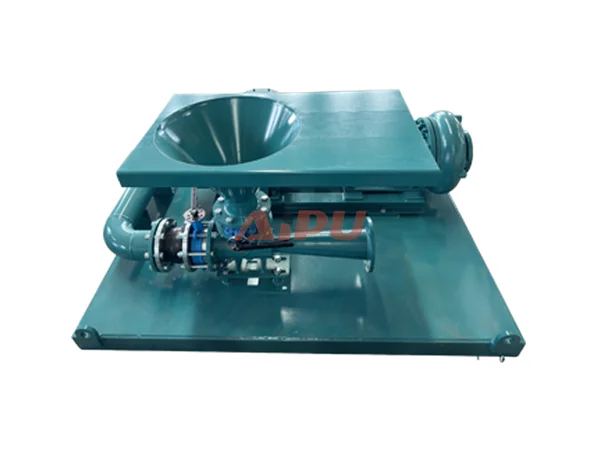
3. How Does a Jet Mixing Device Work? – The Venturi Principle
The jet mixing device operates on a simple but highly effective fluid dynamics principle: the Venturi effect.
Step-by-Step Working Principle:
-
High-pressure fluid supply: A centrifugal pump takes mud from the tank and delivers it at high pressure (typically 0.22–0.4 MPa / 30–60 psi) to the jet mixer’s nozzle.
-
Nozzle acceleration: The fluid passes through a tapered nozzle, which increases its velocity (to 30–50 m/s) while decreasing its pressure.
-
Vacuum creation: The high-velocity jet passes through a Venturi throat, creating a strong vacuum (low-pressure zone) in the mixing chamber.
-
Powder suction: Dry materials (barite, bentonite, polymers) are fed from a hopper through a butterfly valve. The vacuum pulls the powder into the fluid stream.
-
Intense mixing: Inside the Venturi tube, the powder and liquid are turbulently mixed. The high shear forces break down clumps and fully wet every particle.
-
Discharge: The mixed slurry is discharged into the mud tank, usually near an agitator for further homogenization.
The entire process takes only seconds. A well-designed jet mixing device can mix 180 kg/min of clay or 315 kg/min of barite continuously.
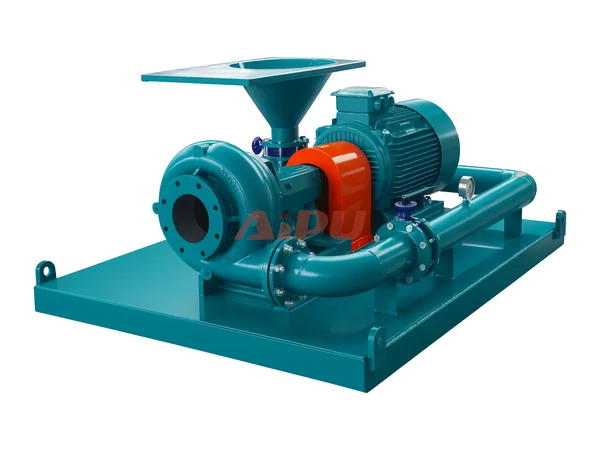
4. Key Components of a Jet Mixing Device
A typical jet mixing device consists of the following parts:
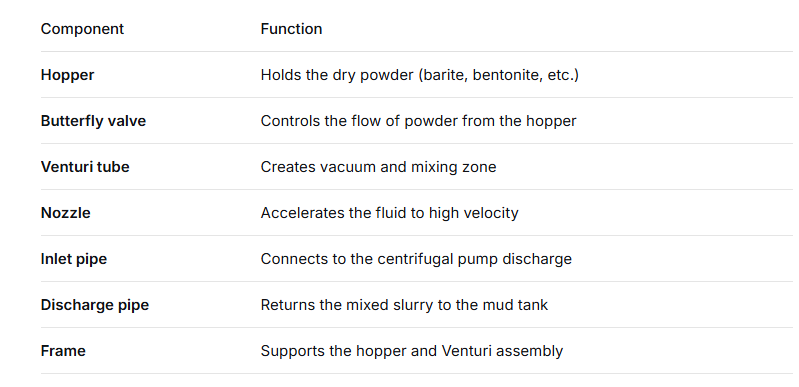
AIPU’s APSLH series jet mixing devices are built with heavy-duty construction, precision-machined nozzles, and corrosion-resistant materials for long service life.
5. Types of Jet Mixing Devices
Depending on the application and tank configuration, jet mixers come in several forms:
5.1 Fixed Jet Hopper (Mounted on Mud Tank)
-
Permanently installed on the mud tank deck.
-
Connected to a dedicated centrifugal pump.
-
Used for routine mud weighting and chemical addition.
5.2 Portable Jet Mixer (Movable Hopper)
-
Mounted on a skid or wheels.
-
Can be moved between tanks or rigs.
-
Ideal for batch mixing or remote locations.
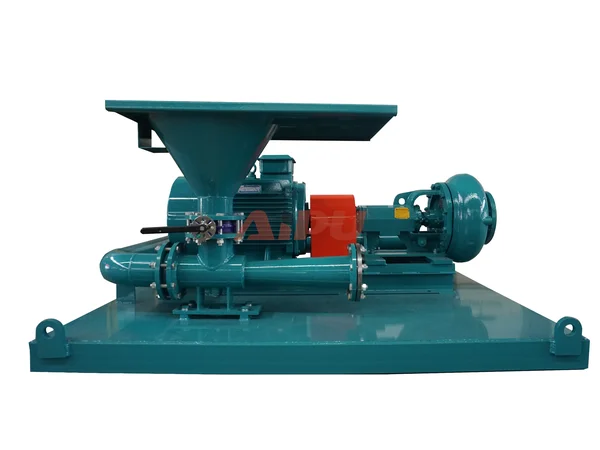
AIPU’s APSLH portable hopper is a fully self-contained unit with a Venturi assembly, butterfly valve, and rugged frame. It connects to any centrifugal pump and can mix clay or barite at high rates.
5.3 Skid-Mounted Jet Mixing Unit
-
Complete system including centrifugal pump, motor, hopper, and piping on a single skid.
-
Used for standalone mixing stations.
6. Applications of Jet Mixing Devices in Drilling
Jet mixing devices are used in every phase of drilling fluid management:
-
New mud preparation: Mixing fresh water, bentonite, and polymers to build a new mud system.
-
Weighting up: Adding barite to increase mud density for deeper sections or well control.
-
Chemical treatment: Adding loss circulation materials (LCM), lubricants, or defoamers.
-
Spud mud mixing: Quick preparation of high-viscosity mud for surface hole drilling.
-
Waste mud reconditioning: Adding polymers to flocculate and recover barite from waste mud.
7. Jet Mixing Device vs. Shearing Pump – What’s the Difference?
Many people confuse jet mixers with shearing pumps. They are complementary, not the same.
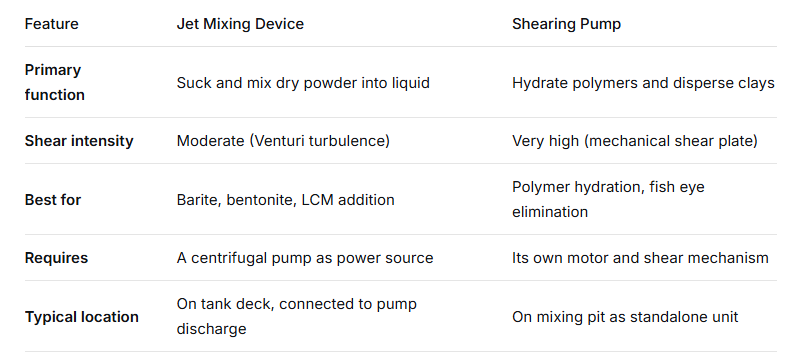
AIPU manufactures both: APSLH jet mixing devices for rapid powder addition, and APJQB shearing pumps for polymer hydration. For best results, many rigs use both.
8. Technical Specifications – AIPU APSLH Jet Mixing Device
AIPU Solid Control offers the APSLH series jet mixing devices with a range of capacities to match any rig size.
AIPU APSLH Series – Key Parameters
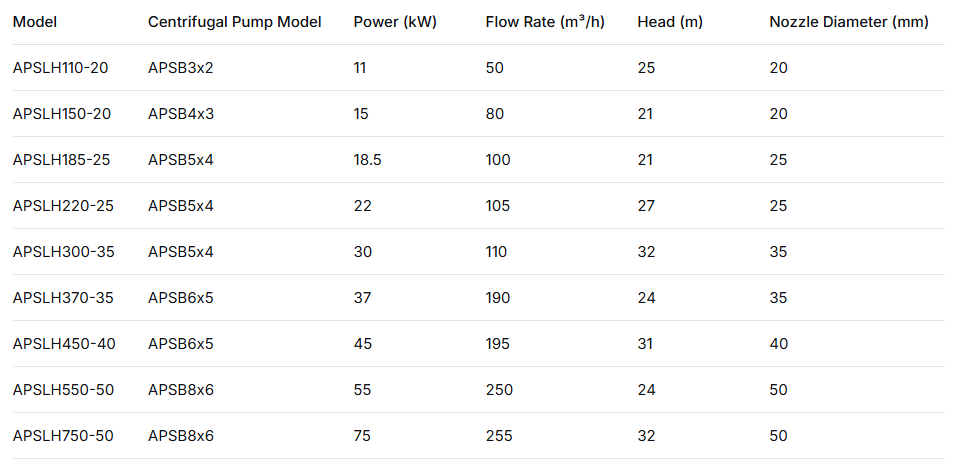
Data sourced from AIPU official product documentation.
Mixing Capacity
-
Clay (bentonite): Up to 180 kg/min
-
Barite: Up to 315 kg/min
These high rates allow rapid mud weight adjustments without slowing down drilling operations.
9. Why AIPU Jet Mixing Devices Are Industry Preferred
AIPU Solid Control has over 20 years of experience in mud solids control and mixing equipment. AIPU jet mixing devices are trusted by drilling contractors in more than 30 countries, with cumulative shipments exceeding 300 system-equivalent products.
Key Advantages of AIPU APSLH Series:
✅ High mixing efficiency – Venturi design creates intense turbulence for complete wetting.
✅ Rapid addition rates – Mix 315 kg/min of barite or 180 kg/min of clay.
✅ Durable construction – Heavy-duty carbon steel or optional H₂S-resistant steel.
✅ Three-layer marine coating – Strict sand-blasting followed by anti-corrosion paint for harsh environments.
✅ Flexible options – Customizable electrical systems (380V/50Hz, 460V/60Hz, etc.).
✅ Certifications – ATEX, IECEX available for hazardous areas.
✅ Portable version – AIPU APSLH portable hopper for movable mixing needs.
✅ Easy maintenance – Simple butterfly valve and nozzle replacement.
10. How to Select the Right Jet Mixing Device
When choosing a jet mixer for your rig, consider:
-
Required mixing rate: How much barite or clay do you need to add per hour? AIPU models range from 50 to 255 m³/h flow rates.
-
Available pump power: The jet mixer requires a centrifugal pump with sufficient head (21–32 m) and flow. AIPU provides matched pump-mixer combinations.
-
Mud type: For H₂S service, choose H₂S-resistant steel construction – available from AIPU.
-
Portability needs: Fixed or portable? AIPU offers both.
-
Hazardous area classification: ATEX/IECEX certification available.
11. Common Misconceptions About Jet Mixing Devices
❌ “A jet mixer can replace a shearing pump.”
False. A jet mixer is excellent for adding barite and bentonite but does not provide the high shear needed for polymer hydration. For polymers, use an AIPU shearing pump.
❌ “Any centrifugal pump works with a jet hopper.”
Not correctly. The pump must provide sufficient head (pressure). Too low pressure will not create enough vacuum. AIPU APSLH series is matched with properly sized AIPU centrifugal pumps.
❌ “Portable hoppers are less effective.”
Incorrect. AIPU portable hoppers use the same Venturi design as fixed units. Their mixing efficiency is identical.
12. Operational Tips for Jet Mixing Devices
To get the best performance:
-
Pre-charge the hopper: Keep hopper full of powder so vacuum immediately pulls material.
-
Maintain pump pressure: Ensure the centrifugal pump delivers the rated head. Low pressure = weak vacuum.
-
Use correct nozzle size: Larger nozzles for high flow, smaller nozzles for high pressure. AIPU provides multiple nozzle options.
-
Clean after use: Flush the Venturi tube with water or base fluid to prevent powder buildup.
-
Inspect butterfly valve: Ensure it opens and closes fully to control powder feed rate.
13. Conclusion: The Jet Mixing Device Is Your Fast, Efficient Mixing Solution
What is a jet mixing device? It is a Venturi-based tool that uses high-velocity fluid to create a vacuum, suck dry powder into the stream, and instantly mix it into drilling fluid. It is the fastest and most efficient way to add barite, bentonite, and other powdered additives to your mud system.
Without a jet mixer, weighting up mud is slow, lumpy, and wasteful. With a high-quality jet mixing device like the AIPU APSLH series, you can add materials at up to 315 kg/min, achieve complete wetting, and maintain consistent mud properties.
AIPU Solid Control designs and manufactures jet mixing devices that are rugged, efficient, and customizable. Whether you need a fixed hopper on your mud tank or a portable unit for remote operations, AIPU has the right solution.
Choose AIPU for faster mixing, less waste, and better drilling fluid performance.
Related Products