What Is a Vacuum Degasser? Operational Principles, Key Benefits & Selection Guide
In the previous article, we introduced the definition and basic working principle of a vacuum degasser. Now, let us take a deeper operational and practical view. For drilling engineers and rig crews, knowing what a vacuum degasser is means understanding when to use it, how to keep it running efficiently, how to tell it apart from other gas removal equipment, and why AIPU Solid Control builds degassers that outperform in the field. This second guide focuses on real‑world operation, comparisons, and selection tips.
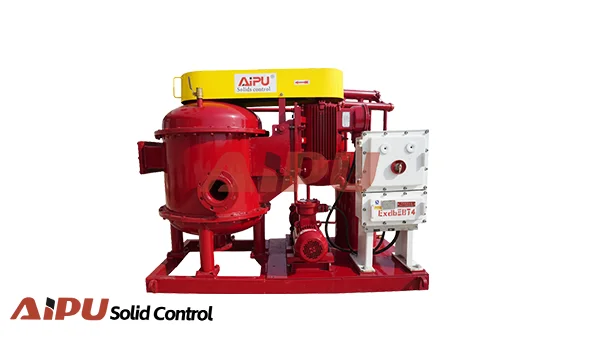
1. Quick Recap: What Is a Vacuum Degasser?
A vacuum degasser is a solids control device that removes entrained gases (small bubbles) from drilling fluid by applying a partial vacuum. It is typically installed after the shale shaker and before the desander/desilter. Its main outputs are:
-
Degassed mud – returned to the mud tank.
-
Extracted gas – sent to a flare or safe vent.
Efficiency: ≥95% for properly sized and operated units like AIPU’s APLCQ and APZCQ series.
2. Why “Vacuum” Matters – The Science of Bubble Removal
Gases in drilling fluid exist in two forms:
-
Free gas – large bubbles, partly removed by the mud gas separator at the flowline.
-
Entrained gas – tiny bubbles (often <1 mm) that are trapped by surface tension and mud viscosity. These are the dangerous ones because they are hard to remove and directly affect mud weight and pump performance.
A vacuum degasser works by lowering the pressure above the mud surface. According to Henry’s Law, the solubility of a gas in a liquid decreases as pressure decreases. Under vacuum:
-
Dissolved gas comes out of solution.
-
Entrained bubbles expand dramatically, become buoyant, and rise to the surface where the vacuum pump pulls them away.
This is why a vacuum degasser is far more effective than an atmospheric degasser or simply letting mud sit in an open tank.
3. Step‑by‑Step Operation on a Typical Rig
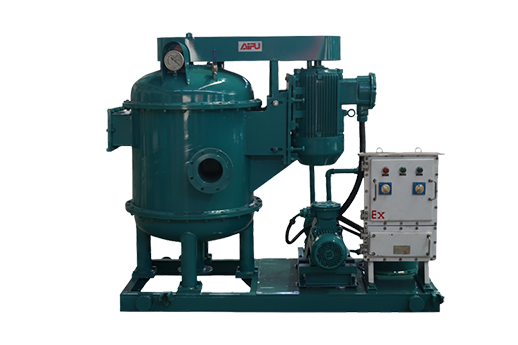
Let us follow a typical degasser cycle on a drilling rig using an AIPU APLCQ300 vertical degasser.
3.1 Pre‑Start Check
-
Ensure the vacuum vessel is clean.
-
Check that the inlet and outlet valves are open.
-
Verify that the vent line is connected to a flare pit or safe area.
-
Confirm that the vacuum pump oil level is correct.
3.2 Startup
-
Start the main motor (22 kW for APLCQ300). The internal rotor or impeller begins to spin, creating a vortex that spreads mud into a thin film.
-
Start the vacuum pump (1.1 kW). The pump reduces pressure inside the vessel to -0.02 to -0.04 MPa.
3.3 Mud Flow
-
Gas‑cut mud enters through the 20″ inlet and hits the distributor or baffles.
-
The thin film exposes a large surface area. Under vacuum, gas bubbles expand and release.
3.4 Gas Removal
-
The vacuum pump continuously draws the released gas out through the 1‑1/2″ vent line.
-
For H₂S or methane, the vent line leads to a flare ignitor (AIPU APFI series) for safe combustion.
3.5 Degassed Mud Return
-
Gas‑free mud falls to the bottom and exits through the 6″ outlet.
-
A centrifugal pump or gravity returns it to the mud tank, usually to the degasser compartment.
3.6 Shutdown
-
Stop the mud feed first.
-
Let the vacuum pump run for 30 seconds to clear residual gas.
-
Stop the vacuum pump, then the main motor.
4. Vacuum Degasser vs. Mud Gas Separator – Critical Differences
Many rig personnel confuse these two. Here is the clear distinction:
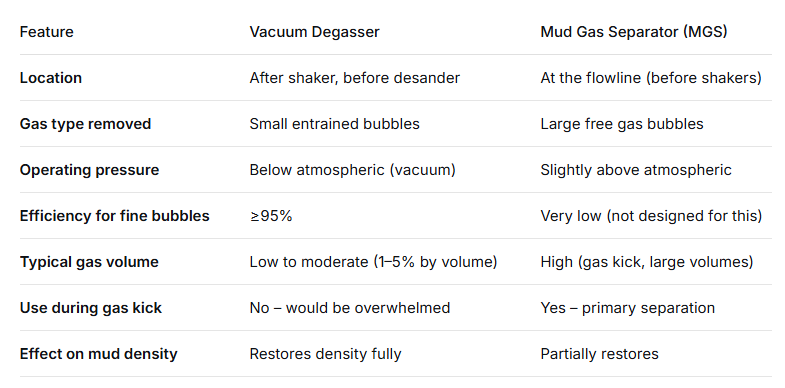
In short: The mud gas separator handles large gas influxes during a kick. The vacuum degasser cleans the mud of fine bubbles during normal circulation. Most rigs need both.
5. Common Operational Problems and Solutions
Problem 1: Low Vacuum (Less than -0.02 MPa)
-
Possible causes: Vacuum pump worn, air leak in seals, vent line blocked.
-
Solution: Check vacuum pump oil and vanes. Inspect lid seals. Clear vent line.
-
AIPU advantage: Tandem mechanical seals and robust vacuum pumps ensure long‑term vacuum stability.
Problem 2: Mud Not Degassed Properly (Gas still present)
-
Possible causes: Flow rate too high (exceeds degasser capacity), distributor worn, mud too viscous.
-
Solution: Reduce feed rate. Inspect distributor. For high‑viscosity mud, pre‑dilute or use a larger degasser.
-
AIPU advantage: APLCQ300 handles 300 m³/h; APZCQ360 handles 360 m³/h – enough for most rigs.
Problem 3: Excessive Vibration or Noise
-
Possible causes: Imbalanced rotor, solids build‑up inside vessel, bearing wear.
-
Solution: Clean vessel. Inspect rotor and bearings.
-
AIPU advantage: Precision‑balanced rotors and heavy‑duty bearings reduce vibration.
Problem 4: H₂S Smell in Discharge
-
Possible causes: Vent line leak, vacuum pump exhausted to wrong location.
-
Solution: Check entire vent path. Ensure flare ignitor is working.
-
AIPU solution: AIPU offers H₂S‑resistant steel degassers and can integrate with APFI flare ignitors.
6. How to Select the Right Vacuum Degasser for Your Rig
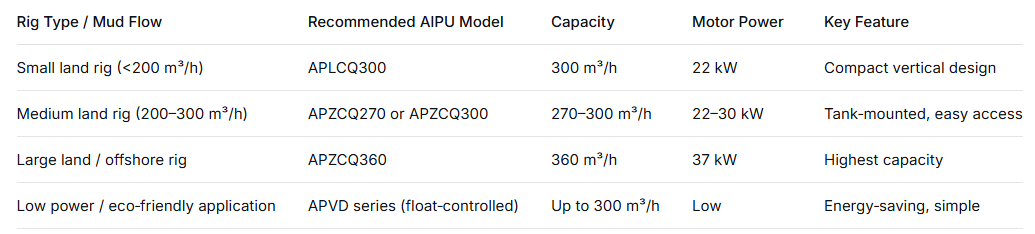
Selection rule of thumb: The degasser’s mud flow capacity should be at least 1.2× your maximum mud pump circulation rate.
7. Maintenance Checklist for Long Life
AIPU vacuum degassers are built tough, but regular maintenance ensures peak performance.
Daily
-
Check vacuum pump oil level and color.
-
Listen for unusual noises.
-
Verify vent line is clear.
-
Check that outlet mud flows smoothly.
Weekly
-
Inspall lid seals for air leaks.
-
Clean the distributor / baffles if needed.
-
Check motor current (should be stable).
Monthly
-
Change vacuum pump oil.
-
Inspect rotor or impeller for wear.
-
Check bearings and lubrication.
Annually
-
Full vessel inspection for corrosion or scaling.
-
Replace worn seals and gaskets.
-
Calibrate vacuum gauge.
8. Why AIPU Vacuum Degassers Stand Out
AIPU Solid Control has over 20 years of experience and a global footprint in more than 30 countries, with over 300 system‑equivalent shipments. AIPU degassers are designed for harsh drilling environments.
Key Differentiators
✅ ≥95% degassing efficiency – Restores mud density quickly.
✅ Wide capacity range – 240 to 360 m³/h (APZCQ series) plus the vertical APLCQ300.
✅ H₂S‑resistant option – 316L or 2205 duplex steel for sour service.
✅ ATEX / IECEX certification – Available for hazardous areas.
✅ Low maintenance design – Simple internal structure, fewer wearing parts.
✅ Three‑layer marine coating – Sand‑blasted, epoxy primer, polyurethane topcoat.
✅ Flexible electricals – 380V/50Hz, 460V/60Hz, or custom.
9. Frequently Asked Questions
Q: Can a vacuum degasser replace a mud gas separator?
A: No. They serve different purposes. The MGS handles large gas volumes during a kick; the vacuum degasser removes fine bubbles during normal circulation.
Q: What vacuum level is best?
A: For most drilling muds, -0.02 to -0.04 MPa (gauge) is ideal. Too high a vacuum can boil off light ends in oil‑based mud. AIPU degassers are designed with adjustable vacuum control.
Q: How do I know if my degasser is working?
A: Measure mud density before and after the degasser. A density increase of 0.02–0.05 SG indicates effective gas removal. Also, check the vent line – you should feel gas flow.
Q: Does the degasser work with oil‑based mud?
A: Yes. However, for oil‑based mud, ensure the vacuum level is not too high (to avoid vaporizing light hydrocarbons). AIPU provides vacuum adjustment.
10. Conclusion: A Vacuum Degasser Is a Critical Investment
What is a vacuum degasser? It is a device that actively pulls entrained gas out of drilling fluid under vacuum, restoring density, preventing pump damage, and improving safety. It is not an option – on any well where gas is expected, a vacuum degasser is essential.
AIPU Solid Control offers reliable, high‑efficiency vacuum degassers that are easy to operate and maintain. From the compact vertical APLCQ300 to the high‑capacity APZCQ360, and the energy‑saving APVD series, AIPU has a degasser for every rig.
Make gas removal simple and effective – choose AIPU.
Related Products