What Is a Vacuum Degasser? Complete Guide for Drilling Operations
In oil and gas drilling, the circulation fluid—drilling mud—serves many critical functions: cooling the bit, carrying cuttings to the surface, and maintaining hydrostatic pressure to prevent blowouts. But when formation gases invade the mud, serious problems arise. The equipment designed to solve this issue is the vacuum degasser. This article provides a complete, standalone introduction to vacuum degassers: what they are, how they work, why they are essential, and how AIPU Solid Control delivers industry-leading degassing solutions.
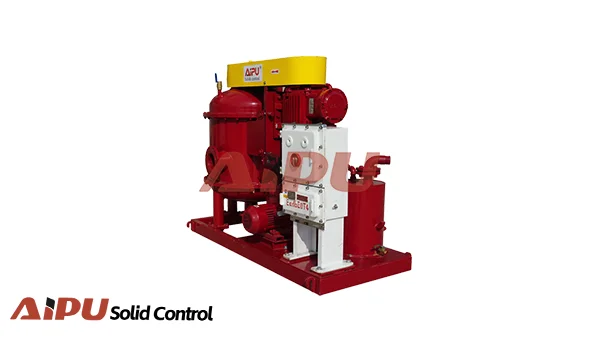
1. Definition: What Is a Vacuum Degasser?
A vacuum degasser is a mechanical device used in drilling fluid solids control systems to remove entrained and dissolved gases from the mud. It operates by creating a partial vacuum inside a sealed vessel, which causes gas bubbles to expand, rise to the surface, and be drawn away by a vacuum pump. The result is clean, degassed mud that can be safely recirculated.
Unlike simple atmospheric tanks or baffle boxes, a vacuum degasser actively pulls gas out of the mud, achieving removal efficiencies of 95% or higher. It is typically installed after the shale shakers and before the desanders or desilters.
2. Why Do Drilling Operations Need a Vacuum Degasser?
When drilling through gas-bearing formations, methane, carbon dioxide, or hydrogen sulfide (H₂S) can enter the mud system. Even small amounts of entrained gas cause multiple problems:
-
Reduced mud density – Gas bubbles lower the hydrostatic column pressure, increasing the risk of a kick or blowout.
-
Pump cavitation – Gas bubbles collapse inside mud pump cylinders, damaging pistons, liners, and valves.
-
Inaccurate flow measurements – Gas interferes with Coriolis and ultrasonic flow meters.
-
Formation damage – Gas can invade permeable zones, reducing productivity.
-
Safety hazards – Toxic gases like H₂S may escape from the mud at the surface.
A vacuum degasser removes these gases efficiently, restoring mud weight, protecting pumps, and ensuring a safe working environment.
3. How Does a Vacuum Degasser Work? – Step by Step
The working principle of a vacuum degasser is based on pressure reduction. According to Henry’s Law, the solubility of a gas in a liquid decreases as pressure decreases. By lowering the pressure above the mud, dissolved gases come out of solution, and existing bubbles expand and separate.
Here is the typical operating sequence:
-
Mud entry – Gas‑cut mud enters the degasser through a large inlet (often 20 inches in diameter) and is distributed onto a set of baffles or a rotating spreader. This creates a thin film, exposing more bubble surface area.
-
Vacuum application – A vacuum pump (or the main motor’s suction effect) reduces the internal pressure to -0.02 to -0.04 MPa (gauge). Under this vacuum, gas bubbles expand dramatically – a 1 mm bubble at atmospheric pressure can grow to 5–10 mm, becoming highly buoyant.
-
Gas release and removal – The expanded gas rises to the top of the vessel and is continuously drawn out through a vent line (typically 1‑1/2 to 2 inches) by the vacuum pump. For hazardous gases, the vent line is connected to a flare ignitor or scrubber.
-
Degassed mud discharge – Gas‑free mud falls to the bottom of the vessel and exits through an outlet (usually 6 inches). A centrifugal pump or gravity returns the clean mud to the mud tank.
-
Continuous operation – The process runs continuously as long as the vacuum pump and mud feed are maintained.
4. Key Components of a Vacuum Degasser
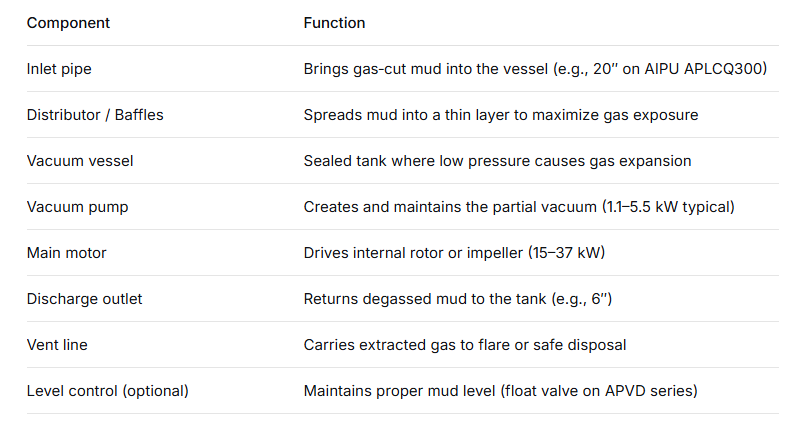
5. Types of Vacuum Degassers
5.1 Vertical Centrifugal Degasser
-
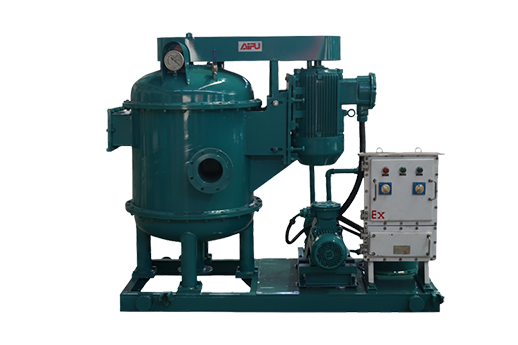
Example: AIPU APLCQ300
-
Uses a high‑speed rotor to fling mud into a thin film against the vessel wall, maximizing gas release under vacuum.
-
Advantages: Compact footprint, no internal moving parts (except rotor), easy maintenance.
-
Capacity: 300 m³/h
5.2 Tank‑Mounted (Horizontal) Degasser
-
Example: AIPU APZCQ series (240–360 m³/h)
-
Mounted directly on top of the mud tank. Mud flows in by gravity from the shaker compartment.
-
Advantages: No external feed pump needed, high capacity, simple installation.
5.3 Float‑Controlled (Energy‑Saving) Degasser
-
Example: AIPU APVD series
-
Uses an internal float valve to maintain constant liquid level, automatically adjusting the vacuum.
-
Advantages: Low power consumption, environmentally friendly, automatic operation.
6. Technical Specifications – AIPU Vacuum Degassers
AIPU Solid Control designs and manufactures vacuum degassers according to API standards and HSE requirements. Below are key models:
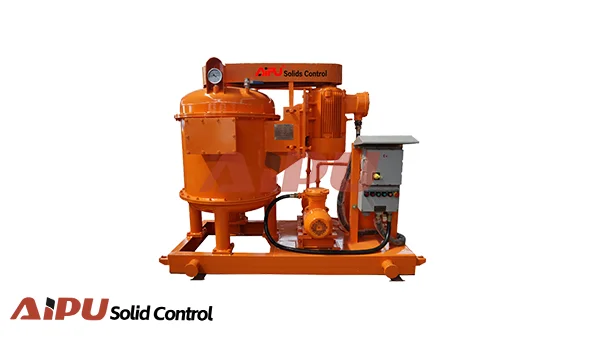
AIPU APLCQ300 Vertical Degasser
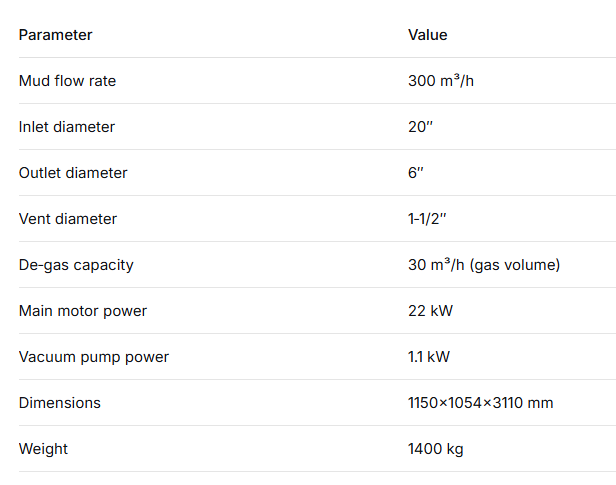
AIPU APZCQ Series Tank‑Mounted Degassers
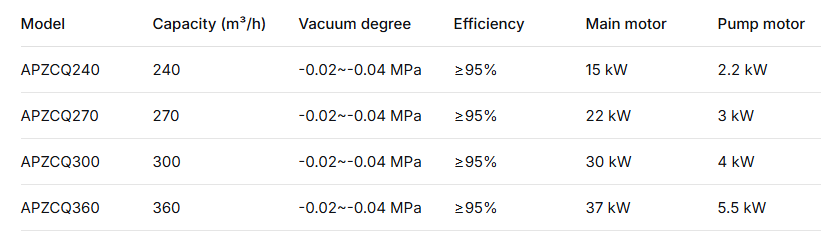
All AIPU degassers are available with customizable electrical systems (380V/50Hz, 460V/60Hz, etc.), ATEX/IECEX certifications, H₂S‑resistant steel (316L or 2205 duplex), and any RAL surface color.
7. Applications of Vacuum Degassers
-
Oil and gas drilling – Standard second‑stage solids control after shale shakers.
-
Geothermal wells – Where formation gases are common.
-
Coal bed methane (CBM) – Methane entrainment is continuous.
-
Sour gas fields (H₂S) – Requires special H₂S‑resistant construction – available from AIPU.
-
Waste mud treatment – Degassing before centrifuge or filter press operation.
8. Vacuum Degasser vs. Other Gas Removal Devices
Many drilling professionals confuse a vacuum degasser with a mud gas separator (MGS). Here is the distinction:
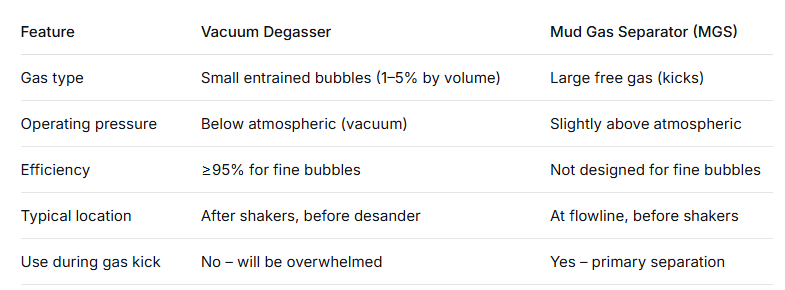
On most modern rigs, both devices are used – the MGS for large gas influxes, and the vacuum degasser for continuous bubble removal during normal circulation.
9. Benefits of Using an AIPU Vacuum Degasser
✅ High efficiency – ≥95% gas removal, restoring mud density to specification within minutes.
✅ Large capacity – Models from 240 to 360 m³/h, covering most land and offshore rigs.
✅ Compact design – Vertical APLCQ300 fits tight spaces.
✅ H₂S‑resistant option – Protects equipment and personnel in sour gas service.
✅ Low maintenance – Simple internal structure, durable components.
✅ Rugged construction – Three‑layer marine anti‑corrosion coating, sand‑blasted surface preparation.
✅ Global certifications – ATEX, IECEX, pressure vessel inspection available.
10. How to Select the Right Vacuum Degasser
When choosing a vacuum degasser for your rig, consider:
-
Mud circulation rate – The degasser capacity should be at least equal to your maximum mud pump output. AIPU offers 240–360 m³/h.
-
Expected gas content – For heavily gas‑cut mud, choose a unit with ≥95% efficiency (all AIPU models).
-
H₂S risk – Specify H₂S‑resistant steel for sour gas fields.
-
Installation space – Vertical units (APLCQ300) require less deck area.
-
Power supply – AIPU can match any voltage/frequency.
-
Hazardous area classification – Request ATEX/IECEX if needed.
11. Common Misconceptions
❌ “A mud gas separator can replace a vacuum degasser.”
False. The MGS handles large gas kicks, not fine entrained bubbles. Both are needed.
❌ “Vacuum degassers only work with water‑based mud.”
Incorrect. They work equally well with oil‑based and synthetic‑based muds, though vacuum levels may need adjustment.
❌ “If I don’t see gas bubbles, I don’t need a degasser.”
False. Dissolved gas does not form visible bubbles until pressure drops. A vacuum degasser removes both dissolved and entrained gas.
12. Why AIPU Solid Control?
AIPU Solid Control has over 20 years of industry experience, specializing in mud solids control and treatment for oil and gas drilling. AIPU products have been delivered to more than 30 countries, with cumulative shipments exceeding 300 system‑equivalent units.
AIPU holds multiple international system certifications, product certifications, and independent invention patents. With a production base of over 50,000 square meters and advanced manufacturing equipment, AIPU ensures professional, high‑quality products. When you choose an AIPU vacuum degasser, you get:
-
Engineering excellence backed by decades of field experience.
-
Full customization to meet your rig’s specific needs.
-
Global after‑sales support and documentation.
13. Conclusion
A vacuum degasser is an essential component of any modern solids control system. By removing entrained and dissolved gases from drilling fluid, it restores mud density, protects mud pumps, improves downstream separation efficiency, and safeguards rig personnel from toxic gases. Whether you are drilling a shallow well or a deep, high‑pressure sour gas reservoir, a reliable vacuum degasser is not optional – it is a necessity.
AIPU Solid Control offers a complete range of vacuum degassers: vertical, tank‑mounted, and float‑controlled. All are built to API standards, available with H₂S‑resistant materials and ATEX certifications, and supported by AIPU’s global service network.
For safer, more efficient drilling, choose AIPU vacuum degassers.
Related Products