How Does a Decanter Centrifuge Work? The Mechanics of High-Speed Solids Separation
A decanter centrifuge, specifically the horizontal spiral discharge type used in drilling operations, operates on a elegantly simple principle: using high-speed rotation to generate tremendous centrifugal force that separates materials based on their density differences. Understanding this mechanical process is essential for optimizing its performance in solids control systems.
1. The Fundamental Principle
At its core, a decanter centrifuge exploits the fact that denser materials experience greater centrifugal force when spun at high speeds. The equipment creates forces exceeding 2,000 times gravity—forces so powerful that solid particles only 2-5 microns in size can be forcibly separated from the surrounding liquid. This is far beyond what screens or hydrocyclones can achieve.
2. Main Components and Their Functions
Before understanding the process, it helps to know the key components:
-
Rotating Bowl: A large cylindrical-conical drum that spins at high speed. The cylindrical section is the settling area, while the conical section (beach) is for dewatering.
-
Screw Conveyor (Scroll): An internal auger that rotates at a slightly different speed than the bowl, continuously conveying settled solids toward the discharge end.
-
Gearbox: Creates the differential speed between bowl and scroll, typically 5-30 RPM difference.
-
Feed Pipe: Stationary pipe that introduces drilling fluid into the rotating assembly.
-
Feed Distributor: Accelerates the incoming fluid smoothly into the bowl.
-
Liquid Discharge Ports: Adjustable weirs or plates at the bowl's large end that control liquid level.
-
Solids Discharge Ports: Openings at the bowl's small end where dewatered solids exit.
3. Step-by-Step Operating Sequence
Step 1: High-Speed Rotation
The bowl and scroll are driven by electric motors through a gearbox system. The bowl rotates at its operating speed—typically 1,500 to 3,200 RPM depending on the model and application. The scroll rotates in the same direction but at a slightly different speed, creating the "differential speed" essential for solids conveyance.
Step 2: Feed Introduction
Drilling fluid enters through the stationary feed pipe. It passes into the feed distributor, which is designed to accelerate the fluid gently to match the bowl's rotational speed. This smooth acceleration prevents turbulence that would otherwise disrupt separation efficiency.
Step 3: Centrifugal Sedimentation
Inside the rotating bowl, the fluid forms a concentric layer against the bowl wall. The tremendous centrifugal force—measured as "G-force" or separation factor—causes denser solid particles to migrate outward and settle against the bowl wall. Lighter liquid phases form inner layers based on their relative densities.
The separation factor (G-force) is calculated as:
G = (Bowl RPM² × Bowl Radius) / 900
From the technical specifications, different models achieve different separation factors:
-
APLW355X1257-N: 2035G at 3200 RPM
-
APLW450X1000-N: 1215G at 2200 RPM
-
APLW450X1350-N: 2250G at 3000 RPM
-
APLW600X1019-N: 755G at 1500 RPM
Higher G-forces enable finer particle separation but require more power and generate greater mechanical stress.
Step 4: Liquid Phase Separation
As solids settle, the clarified liquid (called centrate or effluent) flows toward the large end of the bowl. It must pass over adjustable weirs or through discharge ports before exiting by gravity. The position of these weirs controls the depth of the liquid pool inside the bowl—a critical parameter that affects both liquid clarity and solids dryness.
Step 5: Solids Conveyance
The settled solids on the bowl wall are continuously scraped and conveyed by the scroll toward the conical end. Because the scroll rotates slightly slower (or faster) than the bowl, it acts like a screw conveyor, pushing solids along the wall. This differential speed is carefully selected based on the solids characteristics—too fast and solids may not dewater properly, too slow and solids buildup can occur.
Step 6: Dewatering on the Beach
As solids are pushed up the conical section (the "beach"), they emerge from the liquid pool. Here, additional drainage occurs as liquid drains back into the pool while solids continue toward the discharge ports. The length and angle of the beach significantly influence the final dryness of discharged solids.
Step 7: Solids Discharge
Finally, the dewatered solids reach the small end of the bowl and are ejected through discharge ports. These solids typically have a cake-like consistency, with moisture content depending on feed characteristics and operating parameters.
Step 8: Separate Collection
The two discharge streams—clarified liquid from the large end and dewatered solids from the small end—are collected separately for further processing, reuse, or disposal.
4. Three-Phase Separation Operation
For three-phase decanter centrifuges (models like APLWS355X1460BP-N, APLWS420X1680BP-N), the process is modified to separate two immiscible liquids simultaneously:
-
Three-Phase Configuration: These centrifuges have additional liquid outlets at different radial positions, allowing separate collection of light and heavy liquid phases.
-
Liquid-Liquid Separation: As materials spin, the heavier liquid (typically water) forms a layer outside the lighter liquid (typically oil). Adjustable weirs or centripetal pumps collect each phase separately.
-
Solids Handling: Solids continue to be conveyed and discharged as in standard two-phase operation.
This capability is particularly valuable for oil-based mud waste management, where base oil recovery is economically and environmentally important.
5. Critical Operating Parameters
Several variables affect centrifuge performance:
Bowl Speed: Higher speeds increase G-force, enabling finer particle separation but consuming more power and increasing wear.
Differential Speed: The speed difference between bowl and scroll affects solids residence time and final cake dryness. Lower differential speeds allow more dewatering time but reduce throughput capacity.
Pool Depth: Deeper pools provide longer settling time for liquids but reduce the beach length available for dewatering. Shallower pools do the opposite.
Feed Rate: Higher feed rates increase throughput but may reduce separation efficiency. Optimal feed rate balances capacity with desired separation quality.
Feed Consistency: Stable feed conditions are essential. This is why single screw pumps are commonly used as centrifuge feed pumps—their progressive cavity design provides smooth, pulse-free flow regardless of pressure variations.
6. The Physics of Separation
Understanding what happens at the particle level helps appreciate centrifuge capabilities:
-
Settling Velocity: In a centrifugal field, particles settle according to Stokes' Law, but with gravitational acceleration replaced by centrifugal acceleration. This means particles settle many times faster than they would by gravity alone.
-
Cut Point: The "cut point" or d50 is the particle size at which 50% of particles are removed. For drilling centrifuges, this typically ranges from 2-7 microns depending on operating conditions.
-
Liquid Clarity: The effluent clarity depends on the smallest particles that escape sedimentation—influenced by G-force, residence time, and fluid properties.
7. Application-Specific Operation
The way a centrifuge is operated changes based on its purpose:
In Non-Weighted Mud Systems:
Operators typically run centrifuges at maximum practical G-force to remove as many solids as possible. The goal is comprehensive solids removal to restore mud properties.
In Weighted Mud Systems for Barite Recovery:
Here, operation is more nuanced. The centrifuge is run at lower G-forces or with different pool depths to selectively reject low-gravity drilled solids while allowing heavier barite to remain in the fluid. This requires careful adjustment of operating parameters based on solids analysis.
For Waste Management:
When processing waste streams, the focus shifts to maximum solids dewatering to reduce disposal volumes, often requiring different parameter optimization.
8. Feed System Integration
A decanter centrifuge cannot function properly without an appropriate feed system. The brochure notes that single screw pumps are commonly used as centrifuge feed pumps because:
-
They provide stable, pulse-free flow essential for consistent separation
-
Their progressive cavity design handles varying solids content
-
They maintain constant flow regardless of discharge pressure variations
-
They can pump high-viscosity fluids effectively
Models like APG05-022B through APG90-185B with capacities matching centrifuge throughput are typically selected.
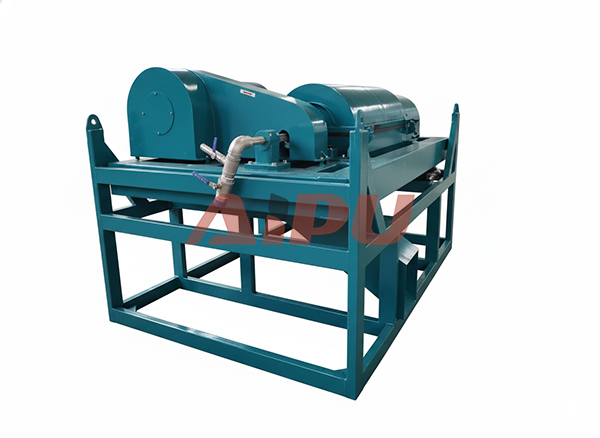
A decanter centrifuge works through a beautifully coordinated mechanical dance: high-speed rotation creates immense centrifugal force; differential screw rotation conveys settled solids; precisely engineered geometry separates and dewaters; and adjustable parameters allow optimization for different applications. Understanding this process enables drilling professionals to maximize the performance of this critical fourth-stage solids control equipment, whether they're purifying non-weighted muds, recovering valuable barite from weighted systems, or reducing waste volumes for environmental compliance. The centrifuge's ability to separate particles as fine as 2-5 microns makes it the ultimate mechanical barrier against harmful solids in the drilling fluid system.
Related Products