What Is a Solids Control System? Design Principles, Configurations, and Economic Impact
In the oil and gas industry, drilling fluid is often called the “lifeblood” of the drilling operation. But every circulation cycle brings drilled solids into the fluid. If these solids are not removed, the mud becomes progressively thicker, less effective, and more damaging to equipment. The solution is a solids control system. While the basic definition is straightforward, understanding how such a system is designed, how it varies between different rig types, and what economic value it brings is essential for any drilling engineer or rig manager. This article provides a comprehensive, standalone explanation of solids control systems from a design, configuration, and cost‑saving perspective, with AIPU Solid Control as the reference equipment provider.
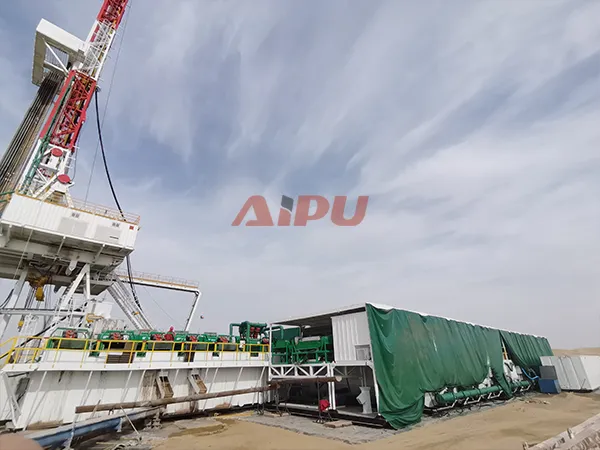
1. What Is a Solids Control System? – A Deeper Look
A solids control system is an integrated arrangement of separation equipment that removes drilled solids (cuttings) from drilling fluid to maintain mud properties within specified limits, allowing the fluid to be reused. It typically includes shale shakers, degassers, desanders, desilters, centrifuges, and supporting devices such as agitators, shearing pumps, jet mixers, and centrifugal pumps.
Beyond the hardware, a solids control system is defined by its design philosophy: selecting the right equipment in the right order, with sufficient retention time and proper tank layout, to achieve a target solids removal efficiency while minimizing mud losses and disposal costs.
2. The Critical Design Principles of a Solids Control System
To build an effective solids control system, engineers follow several key principles.
2.1 Progressive Separation (From Coarse to Fine)
Solids must be removed in descending size order. Removing large particles first prevents them from breaking down into smaller, harder‑to‑remove particles. The typical sequence is:
-
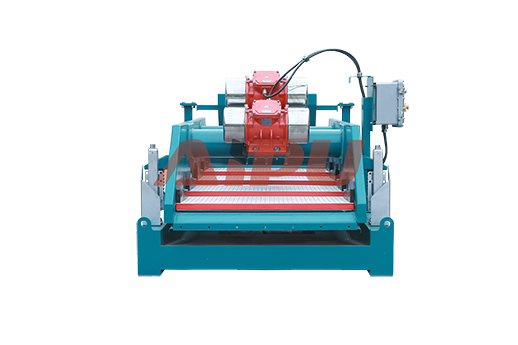
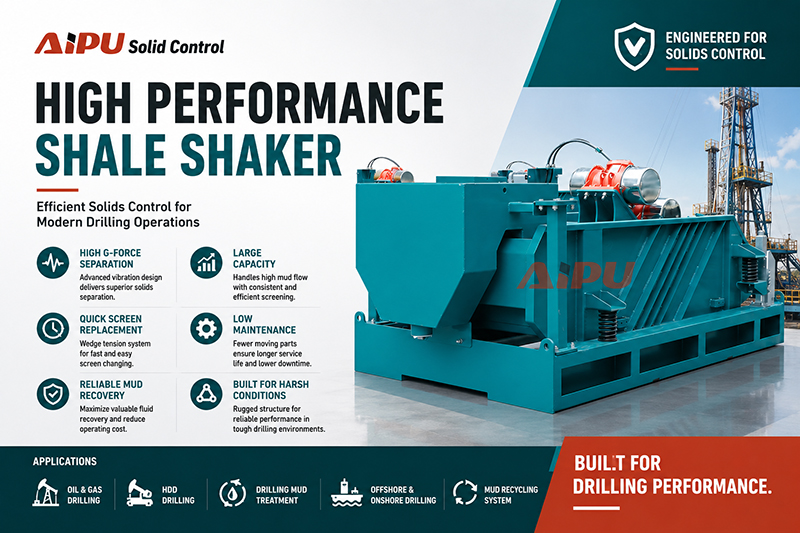
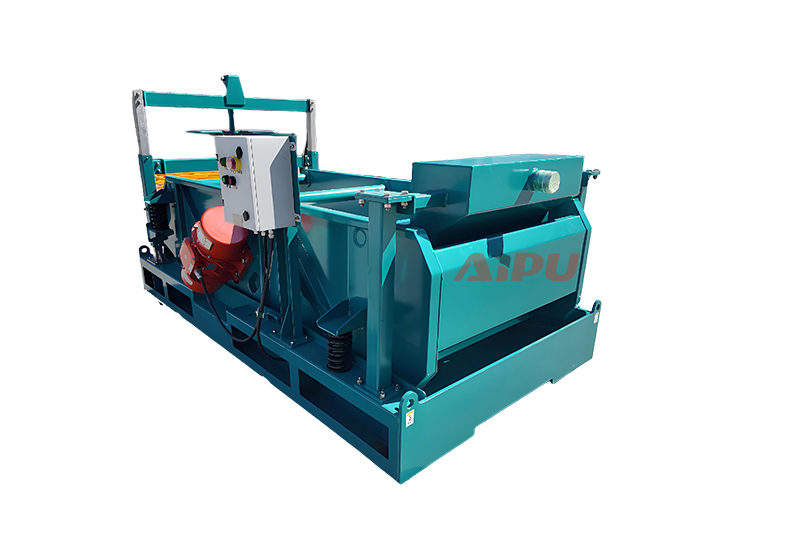
Shale shaker: removes >75 µm
-
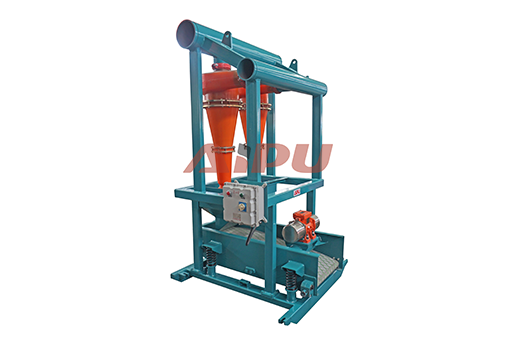
Desander: removes 44–74 µm
-
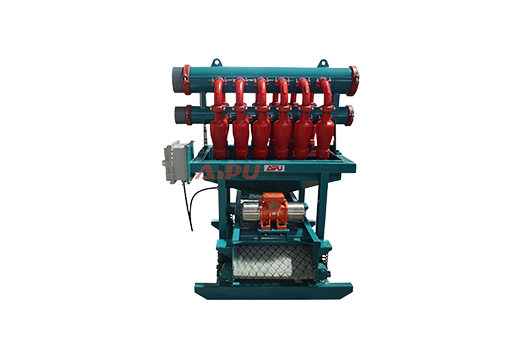
Desilter: removes 15–44 µm
-
Centrifuge: removes 2–7 µm (or recovers barite)
Skipping a stage or placing a finer device before a coarser one causes inefficiency and rapid wear.
2.2 Sufficient Retention Time
Each separation device requires a certain time for solids to settle or be centrifugally removed. For hydrocyclones (desanders/desilters), sufficient retention time in the tank compartment allows larger solids to settle before feeding the cones. For centrifuges, the feed must be consistent. AIPU engineers calculate compartment volumes based on pump rate and solids loading.
2.3 Proper Tank Compartmentation
Mud tanks are divided into compartments using weir plates. The number of compartments varies from 3 to 8, depending on the rig. Each compartment serves a specific purpose: shaker feed, degasser, desander/desilter feed, centrifuge feed, mixing, and suction. A well‑compartmented tank prevents short‑circuiting (mud bypassing equipment) and allows each piece of equipment to operate at its own rate.
2.4 Matching Equipment Capacity to Circulation Rate
The solids control system’s total capacity must at least equal the maximum mud pump output. If the shaker is undersized, mud will overflow the screen. If the centrifuge is too small, fines build up. AIPU offers a full range of capacities: from Hunter‑Mini (50 m³/h) to Hunter‑MG4D (420 m³/h) for shakers, and APLW centrifuges from 35 to 65 m³/h.
2.5 Redundancy and Bypass Capability
Critical equipment (especially shale shakers) often includes dual screens or multiple units so that one can be serviced without stopping the system. AIPU’s Hunter‑MG series includes dual‑motion and multi‑unit configurations.
3. Common Solids Control System Configurations
The layout of a solids control system varies significantly based on rig type and mud program.
3.1 Land Rig (Skid‑Mounted) Configuration
Land rigs typically use 3–5 steel mud tanks in a row. A typical 4‑tank layout:
-
Tank 1 (Shaker/degasser): Shale shakers on top; degasser next; degassed mud flows to Tank 2.
-
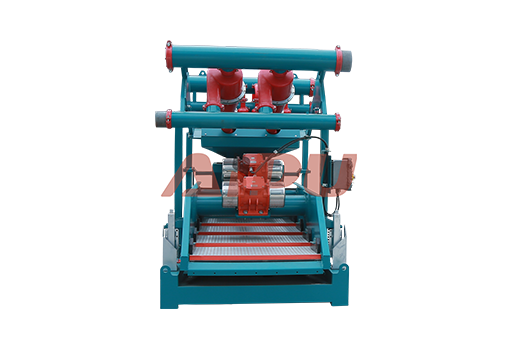
Tank 2 (Desander/desilter): Centrifugal pump feeds desander; overflow goes to desilter; bottom shakers (mud cleaners) optional.
-
Tank 3 (Centrifuge/mixing): Centrifuge for fine solids or barite recovery; jet hopper and shearing pump for chemical addition.
-
Tank 4 (Suction): Clean mud ready for mud pumps; agitators keep solids suspended.
AIPU provides complete skid‑mounted packages with all tanks interconnected, pre‑piped, and coated with three‑layer marine paint.
3.2 Offshore Rig (Jackup / Semi‑submersible) Configuration
Offshore rigs have tight space constraints and higher safety requirements. Common features:
-
Closed or pressurized tanks to prevent spills.
-
Blast‑resistant construction for hazardous areas.
-
H₂S‑resistant steel for sour gas service.
-
Compact vertical degassers (AIPU APLCQ300) to save deck space.
-
High‑capacity centrifuges (AIPU APLW565X2600BP‑N, up to 8900 kg) for barite recovery.
Offshore systems also require ATEX/IECEX certification for all electrical components – AIPU provides this.
3.3 High‑Gas (Sour) Configuration
When drilling through formations containing hydrogen sulfide (H₂S), the system must be designed for safety:
-
Mud gas separator before shakers for large gas kicks.
-
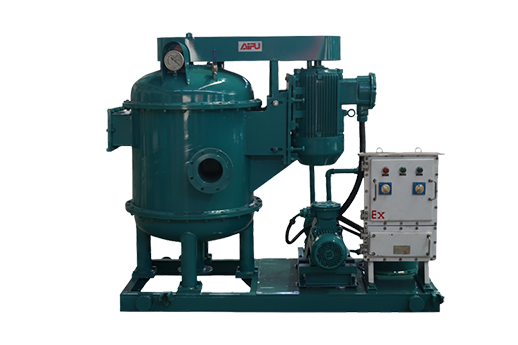
Vacuum degasser (AIPU APZCQ series with H₂S‑resistant steel) for fine bubble removal.
-
Flare ignitor (AIPU APFI series) to burn extracted gas.
-
All wetted parts in 316L or 2205 duplex stainless steel.
AIPU offers full sour‑gas packages with material upgrades and certifications.
4. Solids Control for Different Mud Types
4.1 Water‑Based Mud (WBM)
WBM is the most common. The goal is to remove solids as small as possible to maintain low viscosity and low fluid loss. A typical WBM system includes all four stages (shaker, desander, desilter, centrifuge). The centrifuge is used in unweighted mode to discard ultra‑fine solids.
4.2 Oil‑Based Mud (OBM)
OBM is used for difficult formations (shale stability, high temperature). Because OBM is expensive, the system emphasizes barite recovery using a centrifuge. The centrifuge separates barite (SG ≈4.2) from low‑gravity drilled solids (SG ≈2.6). The recovered barite is returned to the system, and the solids are discarded. AIPU centrifuges are designed for OBM with explosion‑proof motors and H₂S‑resistant options.
4.3 Synthetic‑Based Mud (SBM)
SBM behaves similarly to OBM but with lower environmental impact. The same solids control strategy applies: shaker → degasser → desander → desilter → centrifuge, with centrifuge set for barite recovery. AIPU systems handle SBM without modification except for material compatibility.
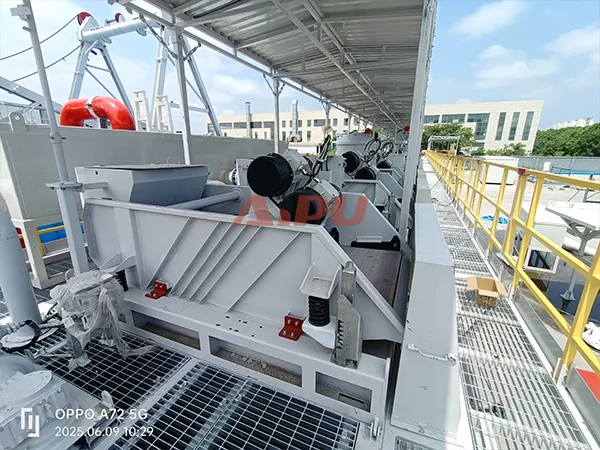
5. The Economics of Solids Control – Why the System Pays for Itself
A properly designed solids control system generates significant cost savings. Let us examine the economics.
5.1 Mud Chemical Savings
Each barrel of mud contains expensive chemicals (barite, bentonite, polymers, etc.). When solids are not removed, dilution is required to keep properties within spec. Dilution means adding new mud and discarding old mud. A good solids control system reduces dilution rate by 50–70%. For a deep well using OBM at $200–400 per barrel, savings can exceed $500,000 per well.
5.2 Equipment Wear Reduction
Solids, especially fine quartz sand, are highly abrasive. Pump liners, pistons, valves, and bit nozzles wear out faster in contaminated mud. Field data from AIPU users show that proper solids control doubles pump liner life and increases bit life by 20–30%.
5.3 Waste Disposal Cost Reduction
Disposing of drilled cuttings and waste mud is expensive, especially offshore. By removing solids efficiently, the system reduces the volume of waste requiring disposal. On a deep well, waste disposal costs can be $50,000–$200,000 lower with an optimized solids control system.
5.4 Penetration Rate (ROP) Increase
Excessive solids in mud reduce ROP. Laboratory and field studies show that reducing low‑gravity solids from 10% to 5% can increase ROP by 20–30%. Faster drilling directly reduces rig time costs (often $50,000–$200,000 per day).
5.5 Return on Investment (ROI)
A complete solids control system (tanks, shakers, degasser, desander, desilter, centrifuge, agitators, pumps) typically costs $500,000–$2,000,000 depending on size. The savings from reduced chemical consumption, longer equipment life, lower disposal costs, and faster drilling often repay this investment within 6–12 months on a continuously operating rig.
6. Key Performance Indicators for a Solids Control System
To evaluate a system’s effectiveness, track these KPIs:
-
Solids removal efficiency – percentage of solids removed by each stage.
-
Mud density variation – should remain within ±0.02 SG.
-
Pump liner life – in hours; doubling indicates good solids control.
-
Centrifuge discharge composition – should be mostly fine solids (unweighted) or heavy barite (weighted).
-
Screen life – longer screen life means less abrasive solids.
7. Why AIPU Solids Control Systems Deliver Superior Value
AIPU Solid Control has over 20 years of experience and has delivered equipment to more than 30 countries, with cumulative shipments exceeding 300 system‑equivalent products. AIPU offers complete, customizable systems including:
-
Shale shakers – Hunter‑MG series (50–420 m³/h, single/dual/triple motion).
-
Vacuum degassers – APLCQ300 (vertical), APZCQ series (tank‑mounted), APVD (float‑controlled).
-
Desanders and desilters – Hunter S/N series, APCS, APCN.
-
Centrifuges – APLW series (35–65 m³/h, 2–7 µm separation).
-
Mud agitators – APMA series (5.5–15 kW, single/dual impeller).
-
Shearing pumps – APJQB series (100–155 m³/h, >95% shear efficiency).
-
Jet mixers – APSLH series (up to 315 kg/min barite).
-
Centrifugal pumps – APSB series (API 7th edition compatible).
-
Mud tanks – custom, sloped bottom, three‑layer marine coating.
All AIPU systems can be supplied with H₂S‑resistant steel, ATEX/IECEX certifications, and any voltage/frequency.
8. Common Misconceptions Addressed
❌ “A single large shale shaker is enough.”
No. Shakers remove only large solids (>75 µm). Finer solids accumulate and must be removed by desanders, desilters, and centrifuges.
❌ “Centrifuges are only for weighted mud.”
False. In unweighted mud, centrifuges remove ultra‑fine solids that cause high viscosity and poor filter cake quality.
❌ “Any tank can be used as a mud tank.”
Incorrect. Proper solids control requires compartmented tanks with sloped bottoms, agitators, and correct weir heights.
9. Conclusion
A solids control system is far more than a collection of equipment. It is a carefully engineered process that removes drilled solids from drilling fluid in a progressive, staged manner, protecting the mud, the pumps, and the wellbore. Proper design – based on circulation rate, mud type, solids loading, and safety requirements – pays for itself through lower chemical costs, less equipment wear, reduced waste disposal, and faster drilling.
AIPU Solid Control provides complete, custom‑engineered solids control systems that meet API and HSE standards, with global delivery and support. Whether you are drilling a shallow well on land or a deep sour gas well offshore, AIPU has the experience and product range to deliver the right solution.
Invest in a high‑performance solids control system from AIPU – and drill cleaner, faster, and more profitably.
Related Products