What is a Mud Agitator? The Mixing Powerhouse of Drilling Fluid Systems
In the complex ecosystem of a drilling fluids solids control system, maintaining uniform mud properties throughout the tank system is essential for consistent performance. While shale shakers, desanders, desilters, and centrifuges focus on removing solids, the mud agitator serves a different but equally critical purpose: keeping solids suspended and ensuring homogeneous mixture. Without proper agitation, even the best-processed drilling fluid will stratify, with heavy solids settling to the bottom and compromising every subsequent operation.
1. Definition and Core Function
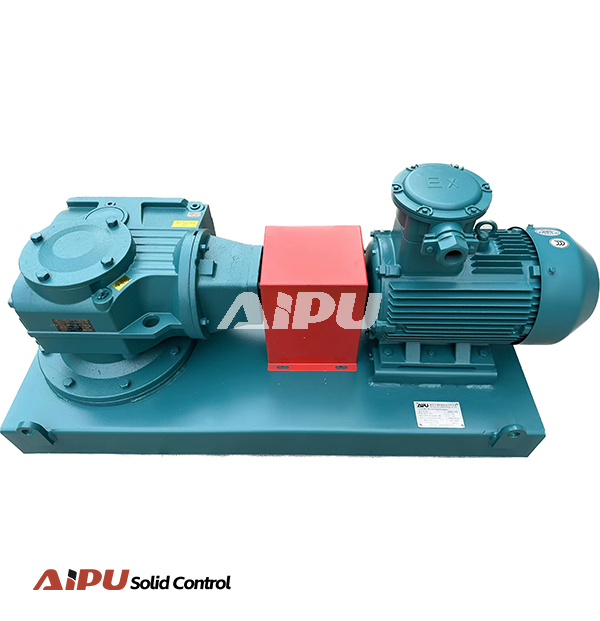
A mud agitator is mechanical mixing equipment installed on surface mud tanks to suspend solids and maintain a homogeneous mixture throughout the drilling fluid system. Its primary function is to prevent solid phase particles from depositing in the tank circulation system, ensuring that the circulating drilling fluid maintains stable and uniform properties. By continuously stirring the mud, agitators eliminate dead zones where solids could accumulate, guaranteeing that the fluid entering the suction lines for downstream equipment and mud pumps has consistent density and rheology.
2. The Role in the Solids Control System
Unlike other solids control equipment that actively separate and remove particles, the mud agitator plays a passive but essential supporting role:
-
Prevents Solids Settling: Without continuous agitation, drilled solids and weighting materials would settle due to gravity, creating stratification and potentially causing equipment plugging or pump cavitation.
-
Ensures Uniform Properties: Agitation maintains consistent density, viscosity, and chemical composition throughout the tank system, ensuring that the fluid pumped downhole has predictable, controlled characteristics.
-
Enables Effective Processing: By keeping solids suspended, agitators ensure that downstream equipment—desanders, desilters, and centrifuges—receive representative fluid with properly distributed solids, allowing them to operate efficiently.
-
Facilitates Mixing and Chemical Treatment: When new materials are added or chemical treatments are applied, agitators distribute them uniformly throughout the tank volume.
Typically, mud agitators are installed one every 3 meters along the tank, or one per compartment, ensuring complete coverage of the tank volume.
3. How Does a Mud Agitator Work?
The operating principle of a mud agitator is straightforward but mechanically robust:
-
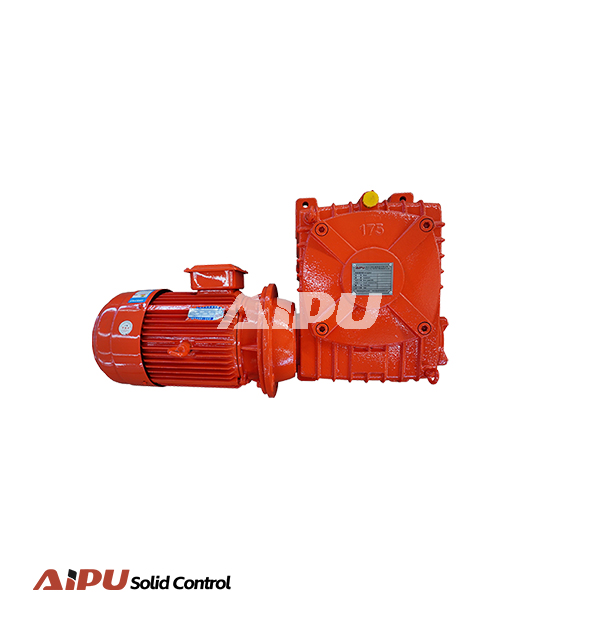
Power Transmission: An electric motor drives a gearbox, which reduces the rotational speed while increasing torque. This low-speed, high-torque output is essential for moving viscous drilling fluids.
-
Shaft Rotation: The gearbox drives a vertical shaft extending down into the mud tank to the required depth.
-
Impeller Action: At the end of the shaft, one or more impellers rotate, creating flow patterns that keep solids suspended. The impeller design creates both axial and radial flow, lifting solids from the tank bottom and circulating fluid throughout the tank volume.
-
Flow Patterns: The rotating impeller generates a combination of vertical circulation (lifting from bottom to top) and horizontal dispersion, preventing dead zones where solids could accumulate.
4. Key Components and Technical Specifications
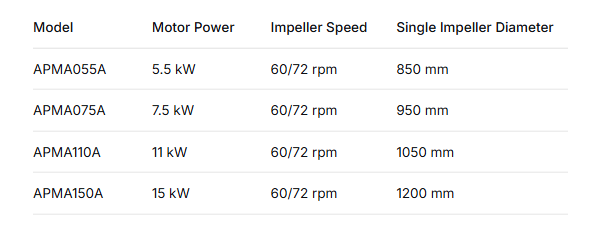
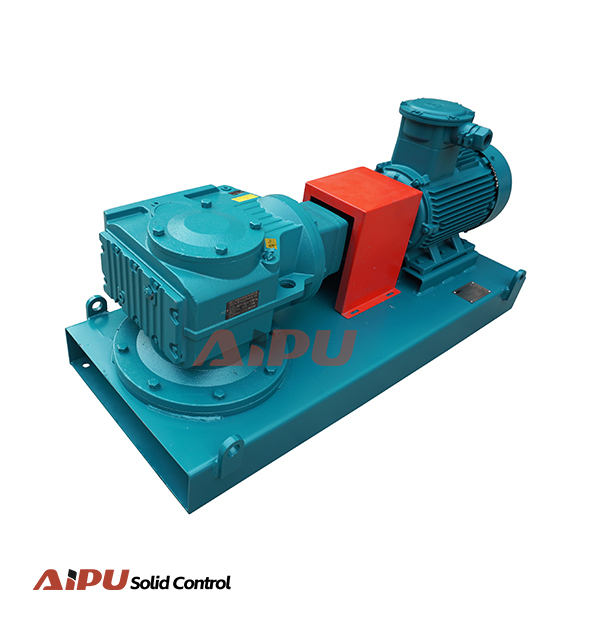
Based on industry-standard configurations like the APMA series, mud agitators incorporate several critical components:
Gearbox: The heart of the agitator, providing speed reduction and torque multiplication. Common configurations include:
-
Worm gear drives
-
Bevel gear drives
-
Ratio typically 25:1
Electric Motor: Provides primary power, available in various ratings:
Shaft Assembly:
-
Shaft length is customized based on tank depth
-
Shaft stabilizers are available for longer shafts to prevent deflection
-
Material options can be specified based on fluid corrosivity
Impellers:
-
Single Impeller Configuration: Used for standard tank depths
-
Dual Impeller Configuration: For deeper tanks, with upper and lower impellers properly spaced:
-
Upper impeller diameters: 800-950 mm depending on model
-
Lower impeller diameters: 800-950 mm depending on model
-
Mounting Base: Structural steel frame that supports the agitator on the tank top, designed to distribute loads and resist vibration.
5. Main Types and Configurations
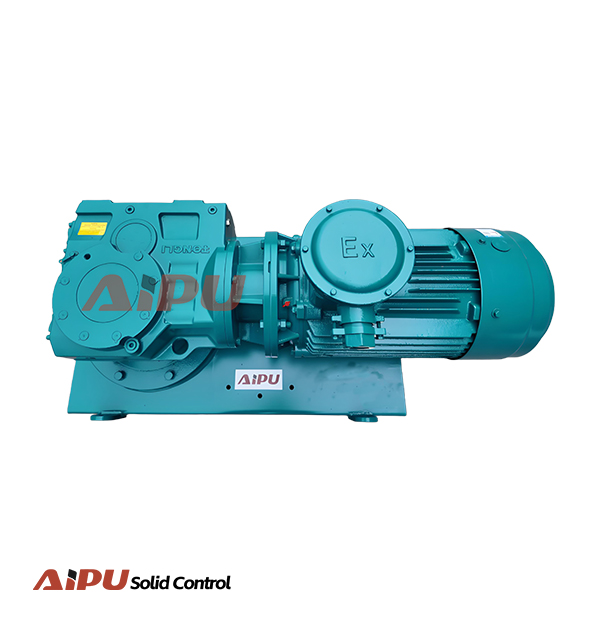
By Gearbox Type:
-
Worm Gear Agitators: Compact design, high reduction ratios, suitable for standard applications. The worm gear design provides smooth, quiet operation with minimal maintenance requirements.
-
Bevel Gear Agitators: Higher efficiency, capable of handling greater loads, suitable for demanding applications with higher viscosity fluids or deeper tanks. Bevel gears offer longer service life under heavy loads.
By Installation Method:
-
Vertical Agitators: The most common configuration, with the motor and gearbox mounted vertically above the tank and the shaft extending straight down into the fluid. The installation area is on the tank surface, making them suitable for standard tank arrangements.
-
Horizontal Agitators: Less common in drilling applications, these are mounted horizontally, typically used in special installation environments where vertical mounting is not feasible.
By Impeller Configuration:
-
Single-Impeller Units: Standard for tanks up to moderate depths, providing adequate circulation with a single mixing element.
-
Dual-Impeller Units: For deeper tanks or more viscous fluids, two impellers provide enhanced circulation throughout the entire fluid column. The upper impeller primarily creates downward flow while the lower impeller generates upward currents, creating comprehensive mixing.
By Shaft Configuration:
-
Standard Shaft: Basic configuration for normal applications.
-
Stabilized Shaft: For longer shafts or higher torque applications, shaft stabilizers (bearings or steady bearings) are installed at intermediate points to prevent shaft whip and ensure smooth operation.
6. Purpose and Advantages
Solids Suspension:
The primary purpose—keeping drilled solids and weighting materials suspended throughout the tank volume. Without agitation, barite and other dense materials would settle within minutes, creating hard packing that is difficult to resuspend and potentially damaging pumps.
Homogeneous Mixture:
Ensuring that drilling fluid properties are consistent throughout the tank system. This uniformity is essential for:
-
Accurate mud testing and property monitoring
-
Consistent performance of downstream solids control equipment
-
Reliable pump operation without density fluctuations
-
Predictable downhole hydraulic performance
Dead Zone Elimination:
Strategic agitator placement eliminates stagnant areas where solids could accumulate. Dead zones create several problems:
-
Localized increases in solids concentration
-
Potential for "gunk" formation where chemical treatments accumulate
-
Inefficient use of tank volume
-
Difficulty cleaning tanks between operations
Chemical Dispersion:
When polymers, viscosifiers, or chemical treatments are added, agitators ensure rapid, uniform dispersion throughout the fluid volume. This prevents:
-
Localized overtreatment
-
"Fish eyes" or undissolved polymer globs that can damage formations
-
Inefficient chemical usage
Temperature Equalization:
In operations where mud temperature is critical, agitation helps maintain uniform temperature throughout the tank, preventing localized hot or cold spots that could affect fluid properties.
Tank Cleaning Facilitation:
When used in conjunction with mud guns, agitators help keep tank bottoms clean by maintaining solids in suspension rather than allowing them to settle and pack.
7. Selection Considerations
Proper agitator selection depends on several factors:
Tank Geometry:
-
Depth determines shaft length and whether single or dual impellers are needed
-
Width and length determine the number of agitators required (typically one per 3 meters or per compartment)
Fluid Properties:
-
Viscosity affects power requirements and impeller design
-
Density influences the torque needed for effective solids suspension
-
Solids content and size distribution affect the mixing energy required
Operating Conditions:
-
Continuous vs. intermittent operation
-
Ambient temperature ranges
-
Hazardous area classifications requiring ATEX or IECEX certification
Customization Options:
As noted in the brochure, mud agitators offer flexible configuration options:
-
Electrical system customizable (voltages, frequencies, certification)
-
Shaft and impeller materials optional based on fluid corrosivity
-
ATEX, IECEX certifications for hazardous locations
-
Surface coating colors for corrosion protection and identification
8. Relationship with Other Equipment
Mud Guns:
Agitators work in conjunction with mud guns, which are auxiliary equipment that:
-
Prevent mud from depositing in the tank
-
Assist in stirring mud and cleaning tank bottoms
-
Available in low, medium, and high-pressure configurations
-
Particularly useful for reaching areas that agitators alone might not fully circulate
Centrifugal Pumps:
Agitators ensure that suction lines for centrifugal pumps receive consistent-density fluid, preventing cavitation and ensuring stable pump performance.
Solids Control Equipment:
By maintaining uniform solids distribution, agitators ensure that desanders, desilters, and centrifuges receive representative feed, allowing these separation devices to operate at their designed efficiency.
The mud agitator may lack the dramatic separation action of a centrifuge or the visible solids discharge of a shale shaker, but its role is no less essential. As the unsung hero of the solids control system, it performs the critical task of keeping solids suspended and maintaining homogeneous mud properties throughout the tank system. Without proper agitation, even the most sophisticated solids control equipment would be rendered ineffective by stratification and settling.
Whether configured as worm gear or bevel gear, vertical or horizontal, single or dual impeller, the mud agitator ensures that the drilling fluid entering the suction lines has consistent properties—density, viscosity, and composition—necessary for reliable pump operation, effective solids control, and predictable downhole performance. In the comprehensive approach to drilling fluid management, the humble agitator proves that sometimes the most important work is the work that goes unnoticed—until it stops.
Related Products