How Does a Vacuum Degasser Work? The Mechanics of Gas Removal from Drilling Fluids
Following the explanation of what a vacuum degasser is, this article focuses specifically on its operating principles—the actual mechanical and physical processes that remove entrained gas from drilling fluids. Understanding how these devices work is essential for proper operation, troubleshooting, and appreciating their critical safety function.
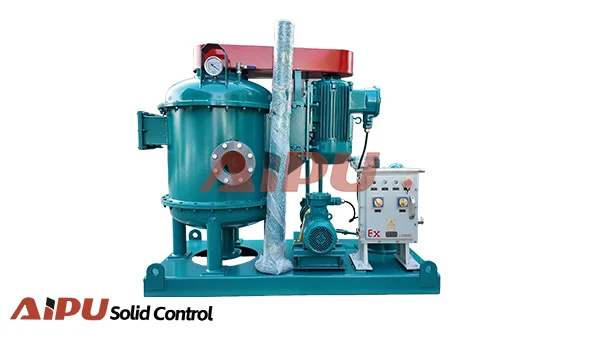
1. The Fundamental Challenge: Why Gas Must Be Removed
Before understanding how a degasser works, it's important to understand what it's fighting against:
Gas Entrainment in Drilling Mud:
When drilling through gas-bearing formations, formation gas can enter the mud system. This gas exists in two forms:
-
Free gas: Bubbles that have already separated from the liquid
-
Dissolved gas: Gas molecules actually dissolved in the liquid phase (more common in oil-based muds)
Additionally, air can be mechanically entrained during:
-
Mud mixing operations
-
Poor pump suction conditions
-
Vortexing in tanks
-
Cascading over weirs
The Problem:
Gas-cut mud has:
-
Reduced density (lighter mud weight)
-
Compressible nature (causes pump cavitation)
-
Potential flammability or toxicity
-
Interference with solids control equipment
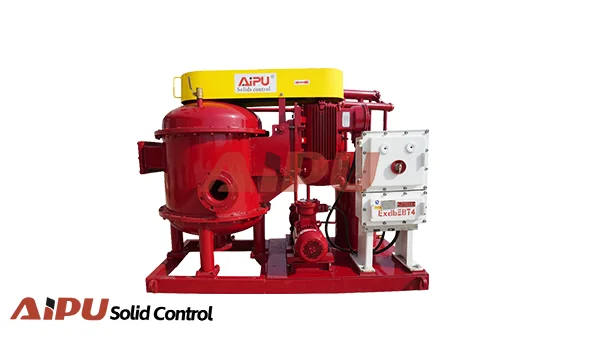
2. The Core Principle: Creating Conditions for Gas Release
All vacuum degassers work on the same fundamental principle: gas comes out of solution more readily when pressure is reduced and surface area is increased.
This is based on Henry's Law, which states that the amount of dissolved gas in a liquid is proportional to the partial pressure of that gas above the liquid. By reducing the pressure above the liquid (creating a vacuum), you reduce the liquid's capacity to hold gas, causing dissolved gas to come out of solution.
Additionally, by increasing the surface area of the liquid (spreading it into thin films or small droplets), you provide more opportunity for gas bubbles to escape.
3. Two Main Approaches to Gas Removal
Based on the brochure specifications, there are two primary designs:
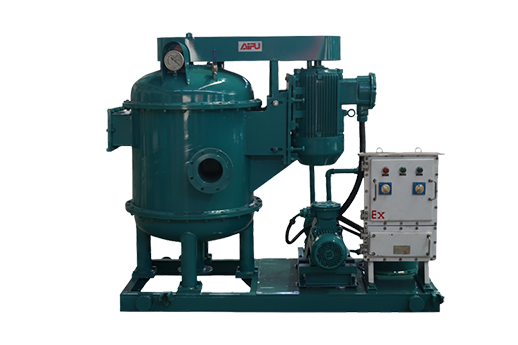
Approach 1: The Vertical/Centrifugal Degasser (APLCQ Series)
Uses centrifugal force to spread mud into a thin film while maintaining near-atmospheric pressure.
Approach 2: The True Vacuum Degasser (APZCQ/APVD Series)
Creates a controlled vacuum environment to maximize gas release, combined with mechanical dispersion.
Let's examine each in detail.
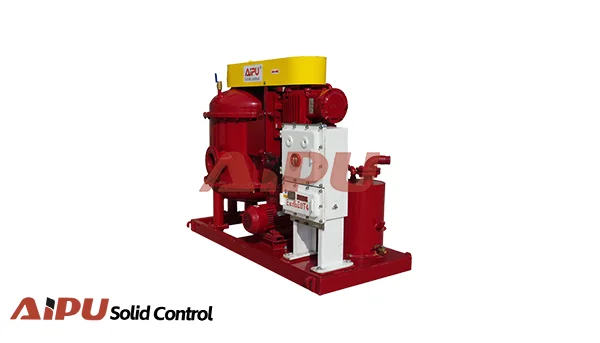
4. How the Vertical/Centrifugal Degasser Works (APLCQ Series)
The vertical degasser, also called an atmospheric or centrifugal degasser, operates on a combination of centrifugal force and thin-film dispersion.
Step-by-Step Operation:
Step 1: Fluid Entry
Gas-cut drilling mud enters the degasser through the large inlet (20" diameter on the APLCQ300) at the top or upper side of the vertical vessel. The large diameter minimizes flow restriction and allows gas to begin separating immediately.
Step 2: High-Speed Rotation
Inside the vessel, a powerful electric motor (22 kW on the APLCQ300) drives a high-speed rotating assembly. This rotation typically ranges from 860 to 880 rpm depending on the model.
Step 3: Centrifugal Dispersion
The rotating element—essentially an impeller or set of vanes—does two things:
-
Flings mud outward: Centrifugal force throws the mud against the vessel walls
-
Creates thin film: The mud spreads into an extremely thin layer as it travels along the walls
Step 4: Gas Liberation
In this thin-film state, several things happen:
-
Entrained gas bubbles rise rapidly to the film surface
-
The reduced pressure (slight vacuum maintained above the mud) encourages bubble expansion
-
Bubbles burst, releasing their gas
-
Dissolved gas begins to come out of solution
Step 5: Vacuum Enhancement
A smaller vacuum pump (1.1 kW on the APLCQ300) maintains a slight negative pressure above the mud. This is not the deep vacuum of a true vacuum degasser, but enough to assist gas release.
Step 6: Gas Collection and Discharge
Liberated gases—methane, H2S, CO2, or air—collect in the upper part of the vessel. The vacuum pump draws these gases out through the vent line (1-1/2" ID) and discharges them to a safe location, typically a flare or vent stack.
Step 7: Degassed Fluid Exit
Gas-free mud, now heavier and incompressible, collects at the bottom of the vessel and exits through the outlet (6" ID). From there, it flows by gravity to the next compartment—typically the desander section.
Step 8: Continuous Operation
The process is continuous. As long as mud enters and the motors run, the degasser keeps removing gas.
Key Physical Mechanism:
The vertical degasser relies primarily on thin-film exposure. By spreading mud into a layer perhaps only millimeters thick, the distance any gas bubble must travel to reach the surface is dramatically reduced. Bubbles that might take minutes to rise in a tank escape in seconds in the degasser.
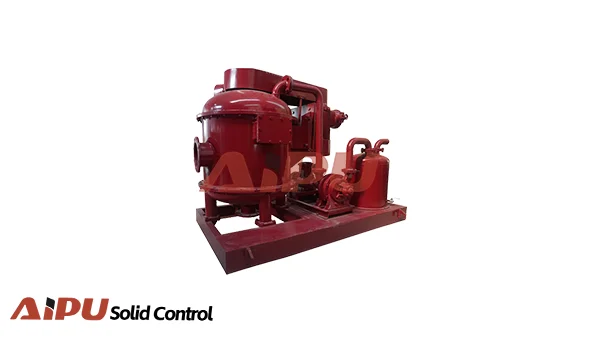
5. How the True Vacuum Degasser Works (APZCQ/APVD Series)
The vacuum degasser takes a different approach, creating a controlled low-pressure environment to actively pull gas out of solution.
Step-by-Step Operation:
Step 1: Vacuum Creation
A vacuum pump (2.2 to 5.5 kW depending on model) continuously evacuates air from the sealed degasser vessel, maintaining a vacuum level of -0.02 to -0.04 MPa (approximately 6-12 inches of mercury vacuum).
Step 2: Fluid Entry
Gas-cut mud is drawn into the vessel through the inlet due to the pressure differential. The vacuum essentially "sucks" the mud into the tank.
Step 3: Gas Expansion
As mud enters the low-pressure environment, any entrained gas bubbles immediately expand—often doubling or tripling in volume. This expansion:
-
Makes bubbles more buoyant
-
Stretches and thins the liquid films surrounding bubbles
-
Causes bubbles to burst more easily
Step 4: Mechanical Dispersion
Inside the vessel, the mud encounters various internal components designed to maximize surface area:
-
Baffles: Force the mud to flow in thin sheets
-
Trays: Cascade mud from level to level
-
Impingement surfaces: Cause splashing and droplet formation
-
Spray nozzles: Atomize mud into fine droplets (in some designs)
The APVD series features an "internal level float control valve" that automatically maintains the proper fluid level, ensuring consistent operation without flooding or running dry.
Step 5: Gas Separation
With maximum surface area exposed and minimum pressure above the liquid, gas comes out of solution rapidly. Dissolved gas evolves into bubbles, and free bubbles rise and burst.
Step 6: Gas Discharge
The vacuum pump continuously draws the liberated gases out through the vent line. For toxic gases like H2S, this line routes to a flare or chemical scrubber.
Step 7: Degassed Fluid Removal
Gas-free mud collects at the bottom of the vessel. An integral centrifugal pump (or in some designs, gravity) moves this mud out through the discharge line to the next processing stage.
Step 8: Level Control
The float valve continuously adjusts to maintain the optimal fluid level—high enough to provide residence time, low enough to prevent liquid from being drawn into the vacuum line.
Key Physical Mechanism:
The vacuum degasser relies primarily on pressure reduction. By lowering the pressure above the liquid, it reduces the liquid's capacity to hold dissolved gas, forcing gas out of solution. This is particularly important for oil-based muds, where gas can be dissolved rather than simply entrained as bubbles.
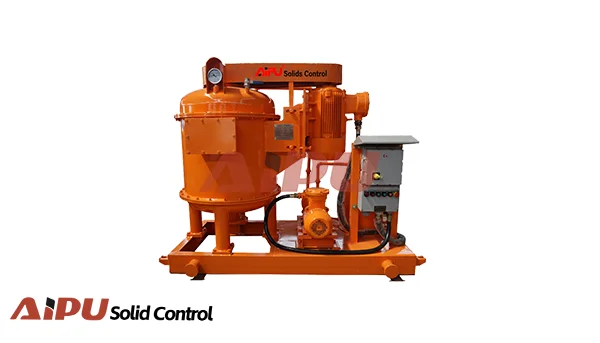
6. The Physics of Gas Removal
Understanding what happens at the molecular level helps explain why degassers work:
For Free Gas (Bubbles):
-
In the mud tank, bubbles rise slowly due to mud viscosity
-
In the degasser, thin-film exposure reduces the distance to surface from meters to millimeters
-
Vacuum causes bubbles to expand, increasing buoyancy
-
Result: Seconds instead of minutes for bubble release
For Dissolved Gas (Oil-Based Muds):
-
Gas molecules are actually trapped between oil molecules
-
They remain dissolved until pressure drops
-
When vacuum reduces pressure below the saturation point, gas comes out of solution
-
It forms new bubbles that then behave like free gas
-
This is why vacuum is essential for oil-based muds
The Efficiency Factor:
The brochure specifies "≥95%" efficiency for the APZCQ series. This means:
-
95% of entrained gas volume removed in one pass
-
Remaining 5% is typically very fine bubbles or deeply dissolved gas
-
Multiple passes can achieve even cleaner mud
7. Component-Level Operation
The Vacuum Pump:
-
Creates and maintains negative pressure
-
Must handle both air and potentially flammable/toxic gases
-
Typically liquid-ring or rotary vane design
-
Requires regular maintenance (oil, seals, belts)
The Main Motor (Vertical Type):
-
Drives the centrifugal dispersion mechanism
-
15-37 kW depending on capacity
-
Direct-drive or belt-driven to the rotating assembly
-
Must be explosion-proof in hazardous areas (ATEX/IECEX options)
The Level Control System:
-
Critical for consistent operation
-
APVD uses float valve for automatic control
-
Prevents:
-
Flooding (liquid entering vacuum line)
-
Dry running (pump damage)
-
Gas breakthrough (vacuum loss)
-
The Vent Line:
-
Routes liberated gas away from rig
-
Must slope away from degasser (no low spots)
-
No valves that could block flow
-
Connections to flare or safe discharge
8. The Role of Adequate Agitation
The brochure mentions "adequate agitation of the drilling fluid" as important. This refers to:
Within the Degasser:
-
Mechanical dispersion ensures all fluid contacts the gas-release surface
-
No stagnant areas where gas-rich fluid bypasses separation
In the Tank System:
-
Agitators maintain uniform fluid properties
-
Prevent gas from re-entering after degassing
-
Ensure consistent feed to the degasser
9. Comparison of Operating Principles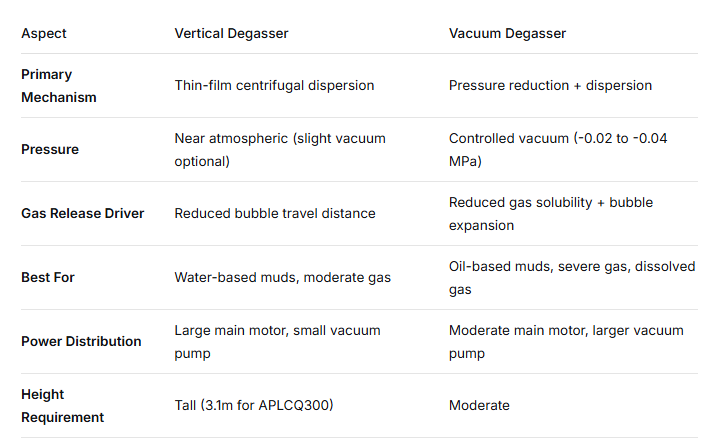
10. What Happens to Different Gas Types
Methane (CH₄):
-
Flammable, lighter than air
-
Readily released by both degasser types
-
Must be vented safely away from ignition sources
Hydrogen Sulfide (H₂S):
-
Toxic, heavier than air
-
Requires special materials (H2S-resistant steel option)
-
Vent must route to flare or scrubber
-
Critical safety device
Carbon Dioxide (CO₂):
-
Can form carbonic acid in water-based muds
-
Affects pH and mud properties
-
Released effectively by vacuum
Air:
-
Entrained during mixing
-
Causes pump cavitation
-
Easily removed
11. The APVD Advantage: Automatic Level Control
The brochure highlights the APVD's "internal level float control valve" as a key feature. Here's why this matters:
Without Automatic Control:
-
Operator must manually adjust valves to maintain level
-
Too high: Liquid enters vacuum line, damaging pump
-
Too low: Vacuum lost, gas removal efficiency drops
-
Constant attention required
With Float Control:
-
Mechanical float senses liquid level
-
Opens/closes valve automatically to maintain setpoint
-
Consistent operation regardless of flow variations
-
Reduced operator workload
-
Prevents damage from improper level
12. Startup and Shutdown Sequence
Proper Startup:
-
Start vacuum pump (establish vacuum)
-
Open inlet valve slowly (allow mud to enter)
-
Check level control operation
-
Start discharge pump (if equipped)
-
Verify vent line is clear
-
Monitor vacuum level and adjust as needed
Proper Shutdown:
-
Close inlet valve (stop mud entry)
-
Allow degasser to empty
-
Stop discharge pump
-
Break vacuum (open vent to atmosphere)
-
Stop vacuum pump
-
Flush if necessary (for polymer muds that could set up)
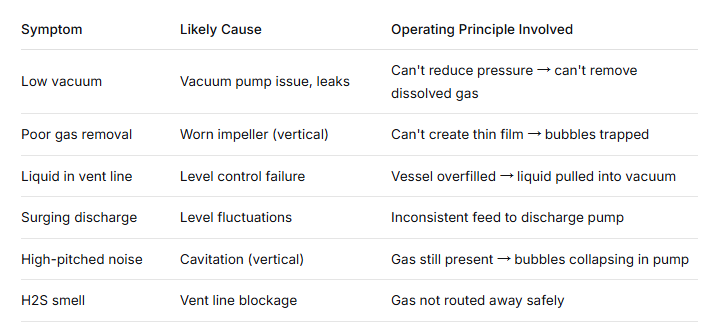
13. Troubleshooting Based on Operating Principles
14. The Physics Summary
In essence, a vacuum degasser works through three physical mechanisms working together:
1. Pressure Reduction:
-
Lowers the pressure above the liquid
-
Reduces gas solubility (Henry's Law)
-
Causes dissolved gas to come out of solution
-
Expands existing bubbles, making them more buoyant
2. Surface Area Increase:
-
Spreads mud into thin films or small droplets
-
Dramatically reduces distance bubbles must travel
-
Exposes more liquid surface to vacuum
-
Allows gas to escape rapidly
3. Mechanical Dispersion:
-
Agitates the fluid continuously
-
Prevents stagnant zones
-
Ensures all fluid is treated
-
Breaks up foam and large bubbles
15. Integration with Other Equipment
The degasser's operation depends on proper system integration:
Upstream:
-
Shale shakers remove large solids that could damage degasser internals
-
Flow from shakers should feed directly to degasser
Downstream:
-
Degassed mud flows to desanders/desilters
-
Gas-free mud allows hydrocyclones to operate efficiently
Vent System:
-
Must handle peak gas flow
-
No restrictions that could create backpressure
-
Safe discharge location downwind of rig
Conclusion
A vacuum degasser works by creating conditions that force entrained and dissolved gas out of drilling fluid. Whether through the thin-film centrifugal dispersion of a vertical degasser or the controlled low-pressure environment of a true vacuum degasser, the goal is the same: reduce the distance bubbles must travel to escape, and reduce the pressure that keeps gas dissolved.
The vertical degasser relies primarily on mechanical dispersion—spinning mud into thin films where bubbles can quickly rise and burst. The vacuum degasser adds the power of pressure reduction, actively pulling gas out of solution and expanding bubbles for easier release. Both achieve efficiencies exceeding 95%, removing methane, H2S, CO2, and entrained air.
In the comprehensive solids control system, the vacuum degasser proves that sometimes the most critical separation is not solid from liquid, but gas from liquid—removing the invisible threat that can turn a routine drilling operation into a life-threatening emergency.
Related Products