What is a Mud Agitator? Complete Technical Guide to Drilling Mud Suspension Equipment
In any oil and gas drilling operation, the drilling fluid—or "mud"—is the lifeblood of the wellbore. It cools the bit, carries cuttings to the surface, and balances formation pressure. However, maintaining the stability of this complex fluid is not just about mixing it correctly; it is about keeping it uniform over time. This is precisely where the mud agitator becomes indispensable.
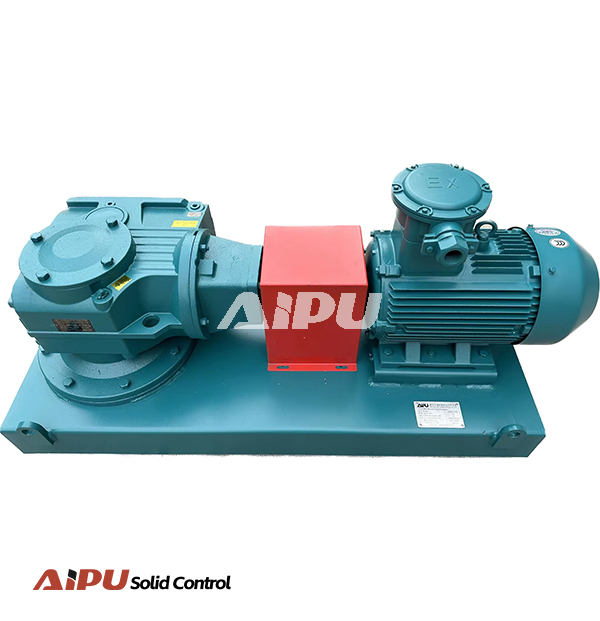
A mud agitator is a specialized piece of solids control equipment designed to provide continuous, low-shear mixing within large mud storage tanks. Its sole mission is to prevent the sedimentation of heavy solids and ensure that every gallon of mud pumped downhole has the exact same density and rheological properties. This article offers a detailed technical exploration of what a mud agitator is, how it functions, and what makes it a critical component of modern drilling rigs.
What is a Mud Agitator? Definition and Core Purpose
A mud agitator is a vertically mounted, top-entering mechanical mixer that utilizes a motor-driven impeller to create a continuous axial flow pattern inside a mud tank. Its primary objective is solids suspension—keeping weight materials (barite), fine drilled cuttings, and chemical additives evenly distributed throughout the liquid column.
Unlike equipment intended for high-shear hydration or initial powder wetting, the mud agitator operates continuously at relatively low speeds. Its purpose is maintenance of homogeneity, ensuring that mud stored in reserve pits or active tanks remains ready for immediate use without the need for re-mixing.
Why is Continuous Agitation Essential?
Without effective agitation, drilling mud is subject to gravitational settling. The consequences of inadequate mixing include:
-
Density Stratification: Barite (specific gravity ~4.2) settles to the tank bottom. Mud pumped from the top of the tank will be underweight, reducing hydrostatic pressure and increasing the risk of well control incidents.
-
Tank Dead Zones: Settled solids compact into a hard layer on the tank floor. This reduces usable tank volume and requires costly, time-consuming manual clean-out.
-
Chemical Inefficiency: Polymer chains and other additives do not perform as designed if they are concentrated in pockets rather than dispersed uniformly.
-
Premature Equipment Wear: Pumps ingesting slugs of dense, abrasive settled solids experience accelerated wear on liners, pistons, and valves.
Detailed Component Breakdown of a Mud Agitator
A high-performance mud agitator consists of four principal assemblies, each engineered for durability in harsh drilling environments.
1. Explosion-Proof Motor
Drilling locations are hazardous areas. The electric motor driving the agitator must be explosion-proof (Ex d) and certified to international standards such as ATEX 94/9/EC or IECEx. Motor power ratings typically range from 5.5 kW to 22 kW (7.5 HP to 30 HP), depending on tank size and mud density.
2. Heavy-Duty Gear Reducer
The gearbox serves a dual function:
-
Speed Reduction: It reduces the motor's input speed (typically 1450-1750 RPM) down to an output speed of 58-72 RPM. This low impeller speed is essential to avoid mechanical degradation of shear-sensitive polymers.
-
Torque Amplification: It provides the massive torque required to turn the impeller through dense, viscous drilling fluid.
Premium agitators utilize spiral bevel gears or helical gears for smooth, quiet operation and extended service life under continuous duty.
3. Agitator Shaft and Coupling Assembly
The shaft is a critical structural component. It is typically fabricated from heavy-wall seamless steel tube and features a keyed end for impeller attachment. The shaft connects to the gearbox output via a rigid flange coupling, which ensures precise alignment and minimizes radial runout and vibration.
4. Impeller (Marine Propeller Type)
The impeller is the fluid-end component that generates flow. Drilling mud agitators almost exclusively use marine-style axial flow propellers with three or four pitched blades.
-
Blade Design: Curved blades with a hydrofoil cross-section maximize fluid movement while minimizing power consumption.
-
Material: Constructed from high-chrome cast iron or stainless steel to resist the abrasive wear of sand and barite.
-
Flow Direction: Standard configuration is down-pumping, which directs flow toward the tank floor to scour settled solids upward along the tank walls.
How Does a Mud Agitator Work? The Principle of Axial Flow Suspension
The operation of a mud agitator relies on creating a predictable, tank-wide circulation pattern called toroidal flow.
Step 1: Power Input and Speed Conversion
The explosion-proof motor runs at full speed. Power enters the gearbox, where it is converted from high-speed/low-torque to low-speed/high-torque. The gearbox output shaft rotates the connected agitator shaft at a constant 58-72 RPM.
Step 2: Axial Thrust Generation
As the marine impeller rotates, its pitched blades function as a low-head, high-volume pump. The blades generate axial thrust, pushing a large column of fluid vertically downward toward the tank floor. This is a gentle, non-shearing movement.
Step 3: Tank Floor Scour and Radial Dispersion
The downward fluid jet strikes the tank bottom and is deflected radially outward in all directions. This high-velocity floor jet effectively sweeps settled barite and cuttings away from the center and toward the tank perimeter.
Step 4: Upward Return Flow and Suspension
After reaching the tank walls, the fluid turns upward and rises along the walls back toward the surface. This upward velocity must exceed the terminal settling velocity of the heaviest particles in the mud. As long as this condition is met, solid particles cannot settle; they remain entrained in the continuous rolling loop.
Step 5: Continuous Homogenization
This process repeats continuously. The entire volume of the mud tank is turned over many times per minute, ensuring that a representative sample taken from the top suction line is identical to a sample taken from the tank bottom.
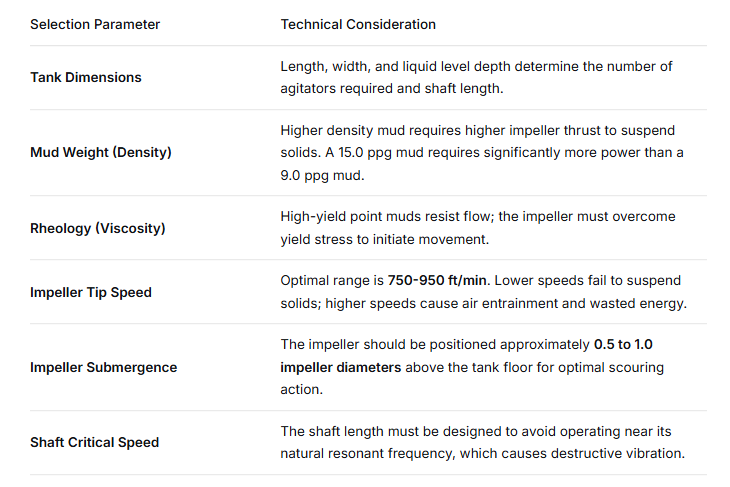
Technical Considerations for Mud Agitator Selection
Selecting the correct agitator requires careful evaluation of several fluid dynamics and mechanical factors:
Routine Maintenance for Extended Service Life
Mud agitators operate in a punishing environment of abrasive fines and corrosive brines. Adhering to a maintenance schedule is essential:
-
Gearbox Oil Management: Check oil level weekly. Drain and refill with specified extreme pressure (EP) gear oil after the first 200 hours of operation, and every 1,000 hours thereafter.
-
Impeller Wear Inspection: During tank clean-outs, inspect impeller blade leading edges for erosion. Severe wear reduces hydraulic efficiency.
-
Mounting Bolt Torque: Periodically check the torque on gearbox mounting bolts and shaft coupling bolts. Vibration can loosen fasteners over time.
-
Vibration Monitoring: A sudden increase in vibration is often an early warning of an unbalanced impeller (due to solids build-up) or a bent shaft.
Mud Agitators in the Drilling Fluids System
The mud agitator is a foundational component within the broader solids control and fluid handling system. Its role is storage conditioning. After the mud has been processed by primary solids removal equipment (shale shakers, hydrocyclones) and adjusted with additives, it resides in large rectangular tanks awaiting recirculation. The agitator guarantees that the fluid properties do not degrade during this dwell time, ensuring the mud pumps always receive a consistent, ready-to-use fluid.
Enhance Your Drilling Efficiency with Aipu Solid Control
The reliability of your mud agitator directly impacts the safety and efficiency of your drilling operation. Aipu Solid Control specializes in the design and manufacture of heavy-duty mud agitators engineered to thrive in the world's most demanding oilfield environments.
Aipu Mud Agitator Features:
-
Premium Gearboxes: Spiral bevel gear reducers with high service factors for 24/7 reliability.
-
Certified Explosion-Proof Motors: Sourced from globally recognized manufacturers, compliant with ATEX/IECEx standards.
-
Optimized Hydrofoil Impellers: Delivering maximum axial flow with minimal power draw.
-
Custom Engineering: Shaft lengths and mounting flanges can be tailored to fit your specific tank configurations.
For detailed product specifications and to discuss your project requirements, visit the official Aipu Solid Control website:
Aipu Solid Control - Mud Agitator Solutions
Contact our engineering support team today for a consultation on your drilling fluid handling needs.
Related Products