What Does a Shearing Pump Do? Key Functions in Drilling Fluid Processing
In the solids control system of oil and gas drilling, every piece of equipment has a specific job. Shale shakers separate large solids, desanders remove sand-sized particles, and centrifuges recover barite. But what does a shearing pump do? Many drilling engineers and rig personnel know the name but are unclear about its actual function. This article provides a clear, detailed answer—explaining exactly what a shearing pump does, why it matters, and how AIPU Solid Control has perfected this technology for the global drilling industry.
1. The Short Answer: What Does a Shearing Pump Do?
A shearing pump does one primary thing: it applies intense mechanical shear force to drilling fluid to break down, hydrate, and disperse polymers and clays that cannot be mixed effectively by ordinary pumps.
In practical terms, a shearing pump turns raw, partially mixed mud with lumps and “fish eyes” into a smooth, uniform, fully functional drilling fluid. Without a shearing pump, polymers and bentonite take hours to hydrate and often leave behind problematic undissolved particles.
2. The Detailed Functions of a Shearing Pump
To fully understand what a shearing pump does, let us break down its specific functions step by step.
Function #1: Rapid Polymer Hydration
Polymers used in drilling fluids (such as PAC, CMC, and polyacrylamide) have very long molecular chains. When added to water or base fluid, they need time and energy to “unfold” and absorb liquid—a process called hydration. Without enough shear, polymers form fish eyes: small, gel-like, unhydrated particles.
What the shearing pump does: It tears apart these fish eyes, forcing the polymer molecules to unfold and hydrate completely. A shearing pump reduces hydration time from 4 hours to just 15 minutes.
Function #2: Efficient Clay Dispersion (Bentonite Savings)
Bentonite clay is essential for viscosity and filtration control. But bentonite particles tend to clump together when mixed with water. Simple agitation or standard centrifugal pumps cannot break these clumps effectively.
What the shearing pump does: It generates high shear forces that separate bentonite platelets, allowing each particle to be wetted and dispersed. This maximizes the yield of bentonite, saving more than 30% of bentonite compared to conventional mixing.
Function #3: Elimination of “Fish Eyes”
Fish eyes are a major problem in drilling operations. They clog shale shaker screens, reduce flow rates, and waste expensive chemicals. Once formed, fish eyes are very difficult to dissolve without high shear.
What the shearing pump does: It physically breaks fish eyes apart through repeated high-velocity impacts between the fluid, nozzles, and rotating shear plate. The result is a completely smooth mud with no gel lumps.
Function #4: Homogenization of Weighting Materials
When adding barite or hematite to increase mud weight, these heavy solids tend to settle quickly if not properly mixed. Uneven distribution leads to density fluctuations downhole.
What the shearing pump does: It creates a homogeneous mixture by ensuring that all solid particles are uniformly suspended before the mud enters the circulation system.
Function #5: Preparation of High-Quality Spud Mud
For surface hole drilling, spud mud must have good viscosity and gel strength to carry cuttings. A shearing pump quickly prepares high-quality spud mud by fully hydrating bentonite and polymers from the very first circulation.
3. What a Shearing Pump Does NOT Do
To avoid confusion, it is also important to understand what a shearing pump does not do:
-
It does not separate solids (that is the job of shale shakers, desanders, and centrifuges).
-
It does not transfer mud over long distances (that is the job of centrifugal pumps).
-
It does not add chemicals automatically (that is the job of dosing systems).
The shearing pump is a preparation and conditioning device, not a separation or transport device.
4. How a Shearing Pump Achieves These Functions – A Quick Look at the Mechanism
Understanding what a shearing pump do is easier when you know how it does it:
-
High-speed rotation: A powerful motor (37–55 kW in AIPU models) spins a special impeller at 1900–2200 RPM.
-
Dual flow paths: Part of the fluid is recirculated through small nozzles and impacts a rotating shear plate.
-
Repeated shearing: The fluid passes through the shear zone many times, breaking down particles and hydrating polymers.
-
Uniform discharge: Fully mixed mud leaves the pump ready for use.
This mechanism is unique to shearing pumps—no other drilling equipment provides this specific function.
5. Where and When Do You Need a Shearing Pump?
A shearing pump is needed whenever drilling fluid must be mixed or conditioned from raw materials. Typical applications include:
-
New mud preparation: When building a fresh mud system from water, bentonite, and polymers.
-
Polymer addition: When adding dry or liquid polymers to an existing mud system.
-
Weight-up operations: Before adding barite to ensure homogeneous viscosity.
-
Waste mud reconditioning: To rehydrate and recover old mud for reuse.
-
CBM and shale gas drilling: Where polymer-based fluids are common.
6. Why AIPU Shearing Pumps Do the Job Better
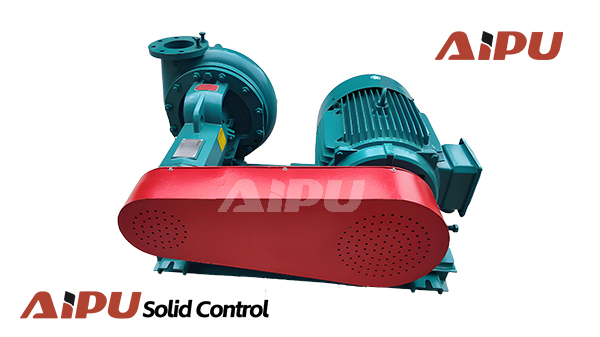
Not all shearing pumps deliver the same results. AIPU Solid Control has over 20 years of experience designing and manufacturing shearing pumps for the harshest drilling environments. Here is what AIPU shearing pumps do better:
AIPU APJQB Series – Key Specifications

What AIPU Shearing Pumps Deliver
✅ Shear efficiency >95% – Hydrates polymers in 15 minutes instead of 4 hours.
✅ Bentonite savings >30% – Reduces material costs significantly.
✅ Fish eyes eliminated completely – No clogged screens, no wasted chemicals.
✅ Robust construction – Hardened 440C stainless steel rotor, tandem mechanical seals, 10,000 hours MTBF.
✅ API 13A compliant – Designed and tested to international standards.
✅ Flexible options – ATEX/IECEX certified, 316L/2205 duplex steel for H₂S service, any voltage or frequency, custom colors.
7. Common Questions About What a Shearing Pump Does
Q: Can a standard centrifugal pump do the same thing?
A: No. A centrifugal pump moves fluid but does not generate high shear. It cannot hydrate polymers or break fish eyes.
Q: Does a shearing pump work with oil-based mud?
A: Yes. AIPU shearing pumps are effective with water-based, oil-based, and synthetic-based muds.
Q: Do I need a shearing pump if I already have a mud mixer?
A: Yes. A mud mixer (jet hopper) works with a centrifugal pump and is good for adding barite, but it does not provide the high shear needed for polymer hydration. A shearing pump is a separate, specialized unit.
Q: How long does a shearing pump last?
A: With proper maintenance, AIPU shearing pumps provide many years of service. The tandem mechanical seal and hardened rotor are designed for continuous heavy-duty operation.
8. Conclusion: What a Shearing Pump Does – And Why You Need One
In summary, a shearing pump does five critical things:
-
Rapidly hydrates polymers (from 4 hours to 15 minutes).
-
Disperses bentonite efficiently (saving >30% material).
-
Eliminates fish eyes completely.
-
Homogenizes weighting materials.
-
Prepares high-quality drilling fluid for safe and efficient drilling.
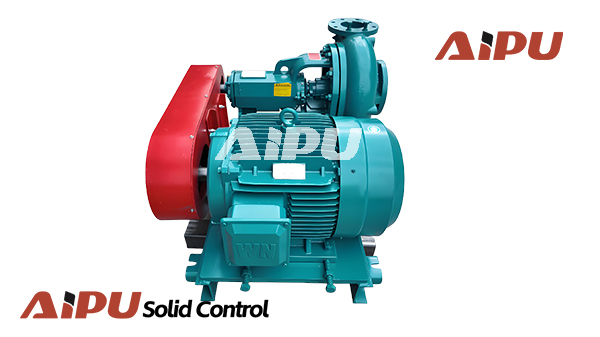
Without a shearing pump, your mud system will suffer from poor hydration, material waste, clogged screens, and higher operating costs. With a high-quality shearing pump like the AIPU APJQB series, you achieve better mud performance, lower chemical consumption, and reduced downtime.
AIPU Solid Control has supplied shearing pumps to over 30 countries, with more than 300 system-equivalent shipments. When you need a shearing pump that does its job reliably, choose AIPU.
Related Products