What Is a Mud Tank in Drilling? Complete Guide to Storage and Circulation Systems
In oil and gas drilling operations, the mud tank is far more than a simple storage container. It is the heart of the solids control system—a carefully engineered vessel where drilling fluid is stored, conditioned, circulated, and prepared for its next trip down the wellbore. Without properly designed mud tanks, even the best shale shakers, desanders, and centrifuges cannot function effectively.
This comprehensive guide answers the question “What is a mud tank in drilling?” in detail, covering its functions, types, key components, and why AIPU Solid Control delivers industry-leading mud tank solutions for onshore and offshore drilling rigs worldwide.
1. What Is a Mud Tank? – Definition
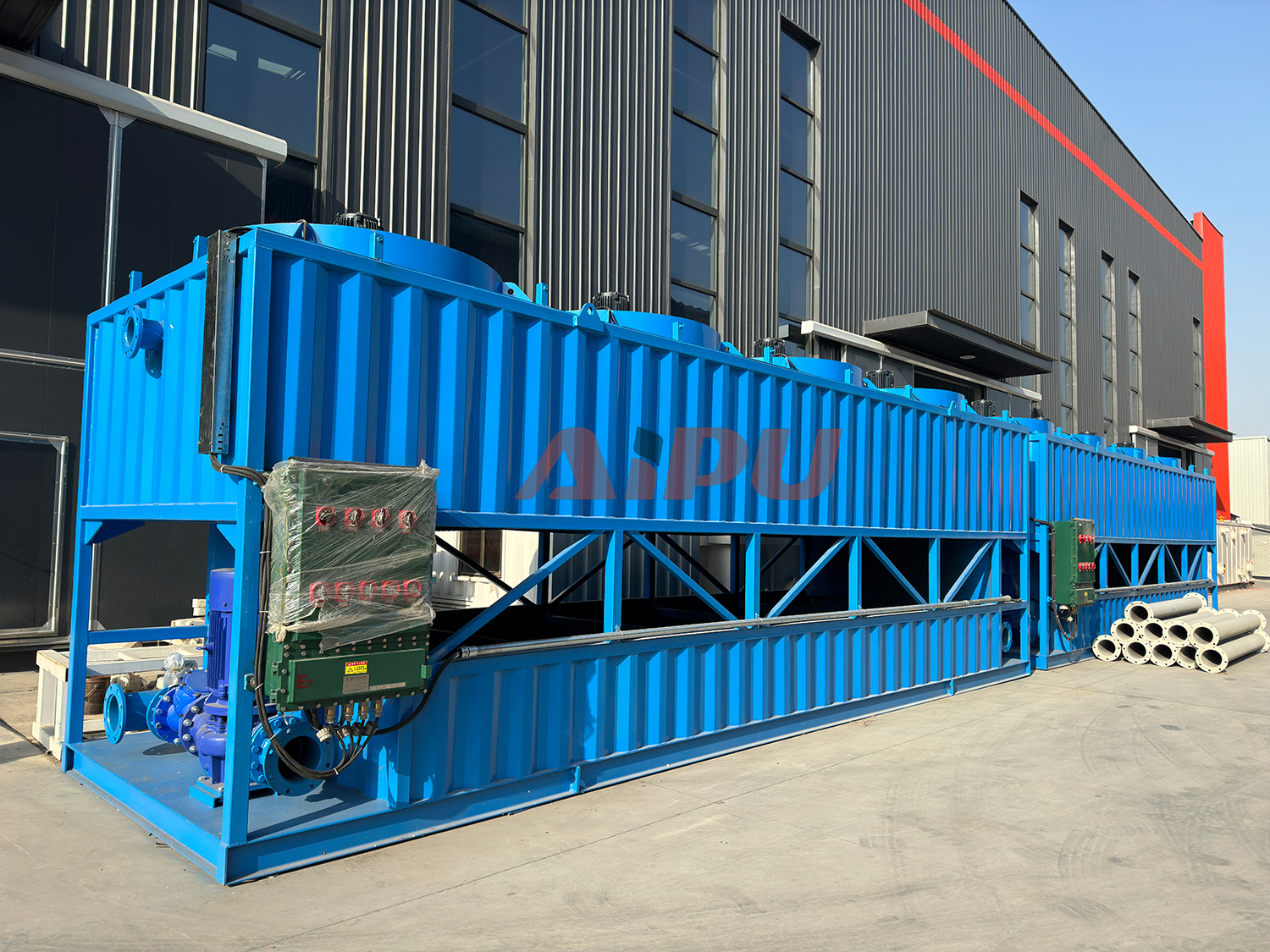
A mud tank (also called a mud pit or mud reservoir) is a large, open-top steel vessel used to store, mix, and circulate drilling fluid during well construction. Mud tanks are typically arranged in series or compartments, each serving a specific purpose in the solids control sequence.
On a modern drilling rig, mud tanks are not just passive containers. They are active processing stations equipped with agitators, pumps, piping, and monitoring instruments that maintain mud properties within required specifications.
2. Why Are Mud Tanks Essential in Drilling?
Drilling fluid circulates continuously from the surface down the drill string, out through the bit, and back up the annulus to the surface. When the mud returns, it carries drilled cuttings and gases that must be removed before the fluid can be pumped down again. The mud tank system provides the space and time for this cleaning process.
Specifically, mud tanks perform six critical functions:
-
Storage – Hold sufficient mud volume to maintain continuous circulation.
-
Settling – Allow large cuttings to drop out before the mud moves to downstream equipment.
-
Degassing – Provide a surface for entrained gas to escape.
-
Mixing and conditioning – Enable addition of barite, polymers, and chemicals.
-
Suction for pumps – Supply clean mud to the mud pumps for re-injection.
-
Emergency reserve – Hold extra mud volume for well control situations.
Without adequate mud tank capacity and design, drilling would stop, wellbore stability would be lost, and kick detection would be impossible.
3. Typical Layout of a Mud Tank System
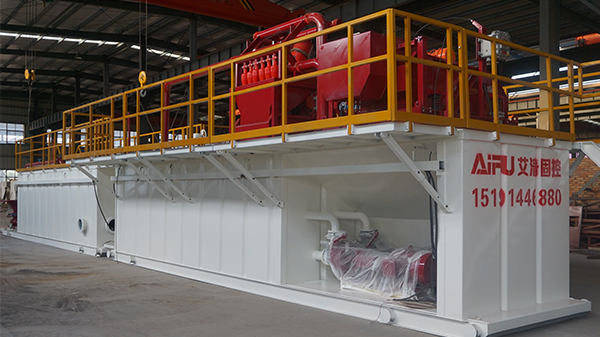
A standard mud tank system is divided into compartments (also called compartments or pits), each with a specific role. From the flow line to the suction pit, the typical sequence is:
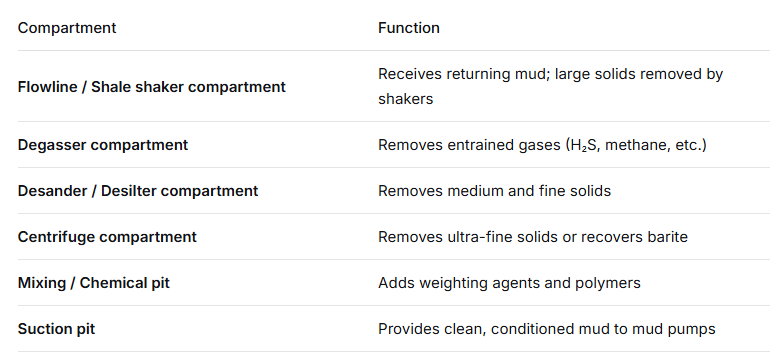
Mud flows by gravity or is pumped from one compartment to the next, progressively getting cleaner.
4. Key Components of a Drilling Mud Tank
A modern mud tank is far more than a steel box. It includes the following essential components:
4.1 Tank Body and Structural Design
-
Made of steel plate (typically 6–10 mm thickness).
-
Reinforced with structural beams and stiffeners.
-
Often sloped or V-shaped bottom to eliminate dead zones and facilitate cleaning.
-
AIPU standard design features sloped bottoms for easy cleaning and less solids accumulation.
4.2 Mud Agitators
-
Mounted on top of each compartment.
-
Prevent solids from settling at the bottom.
-
Typically one agitator per 3 meters of tank length.
-
AIPU APMA series agitators provide reliable, low-speed high-torque mixing.
4.3 Suction and Discharge Piping
-
Manifolds with valves to direct mud flow.
-
Suction lines feed mud pumps, desanders, desilters, and centrifuges.
4.4 Walkways and Guardrails
-
Allow safe access for inspection and maintenance.
-
Non-slip grating is standard.
4.5 Level Indicators and Sensors
-
Mechanical or electronic devices to monitor mud volume.
-
Critical for well control and volume balance.
4.6 Mud Guns (Optional)
-
High-pressure jets that prevent solids from settling in corners.
-
Operated by centrifugal pumps.
4.7 Mixing Hoppers (Jet Hoppers)
-
Used to add barite, bentonite, and chemicals.
-
Mounted on the mixing compartment.
4.8 Shearing Pump (For Polymer Hydration)
-
Installed on the mixing pit to hydrate polymers rapidly.
-
AIPU APJQB series shearing pumps are often integrated into mud tank systems for superior polymer dispersion.
5. Types of Mud Tanks
Depending on the drilling environment, mud tanks come in several configurations:
5.1 Open-Top Steel Tanks
Most common for onshore drilling. Simple, robust, and easy to clean.
5.2 Closed or Pressurized Tanks
Used offshore or in environmentally sensitive areas to prevent spills and vapor release.
5.3 Skid-Mounted Tanks
Mounted on steel skids for easy transport between well sites. Standard in land drilling.
5.4 Trailer-Mounted Tanks
Integrated into a trailer chassis for rapid mobilization.
5.5 Double-Walled Tanks
Used where secondary containment is required for environmental protection.
5.6 Elevated Tanks (Fuel or Water)
Separate tanks for diesel, water, or other fluids, often seen on larger rigs.
AIPU offers all the above configurations, including transfer tanks, elevated fuel tanks, double-layer square oil tanks, and trailer-mounted tanks, all built with heavy-duty marine-grade anti-corrosion coating.
6. Mud Tank Sizing and Capacity Considerations
The required mud tank capacity depends on:
-
Well depth – Deeper wells need more mud volume.
-
Hole diameter – Larger holes hold more cuttings and require more mud.
-
Circulation rate – Mud pump output (typically 800–4,000 L/min).
-
Solids control efficiency – Better equipment reduces tank volume needs.
As a rule of thumb, total active mud volume is usually 1.5 to 3 times the hole volume. Typical tank capacities range from 50 m³ to over 200 m³ per system.
7. How AIPU Designs Mud Tanks for Maximum Performance
AIPU Solid Control has over 20 years of experience in mud solids control and has delivered equipment to more than 30 countries, with cumulative shipments exceeding 300 system-equivalent products. AIPU mud tanks are designed with the following advantages:
✅ Sloped or V-Shaped Bottom
Standard AIPU tank bottoms are sloped (or V-shaped) to eliminate dead corners, making cleaning easy and preventing solids accumulation.
✅ Corrugated Profile Design
Provides both strength and an exquisite appearance, suitable for all mud types: water-based (WBM), oil-based (OBM), and synthetic-based (SBM).
✅ Heavy-Duty Marine Coating
Three-layer anti-corrosion painting after strict sand-blasting ensures long service life even in offshore or desert environments.
✅ Customizable Compartment Layout
AIPU engineers work with clients to design the optimal number and size of compartments based on flow rate, solids loading, and available rig space.
✅ Integrated Equipment Mounting
Tanks are designed to mount shale shakers, desanders, desilters, centrifuges, agitators, shearing pumps, and centrifugal pumps directly on the deck, creating a fully integrated solids control package.
✅ Optional Materials
-
Standard carbon steel or H₂S-resistant steel for sour gas fields.
-
Pressure vessel certification available upon request.
✅ Safety Features
-
Non-slip walkways and guardrails.
-
Emergency shutoffs and level alarms.
8. Common Questions About Mud Tanks
Q: How many mud tanks does a rig need?
A: Most land rigs use 3–6 tanks in series. Deepwater offshore rigs may have 8–12 tanks.
Q: What is the difference between a mud tank and a mud pit?
A: Historically, “mud pit” referred to earthen excavations. Today, “mud tank” means a steel vessel. The terms are often used interchangeably, but steel tanks are standard in modern drilling.
Q: Why are mud tank bottoms sloped?
A: To prevent solids from settling in corners and to allow easy cleaning. AIPU standard design uses sloped or V-shaped bottoms.
Q: Can AIPU customize mud tank dimensions?
A: Yes. AIPU provides fully customized mud tanks based on customer flow rate, tank depth, compartment number, and transportation constraints.
9. Integration with the Full Solids Control System
A mud tank is not an isolated component. It works together with:
-
Shale shakers – First-stage separation on the flowline tank.
-
Degassers – Removed gas from mud.
-
Desanders and desilters – Remove sand and silt-sized particles.
-
Centrifuges – Fine solids removal or barite recovery.
-
Agitators – Keep solids suspended.
-
Shearing pumps – Hydrate polymers efficiently.
-
Centrifugal pumps – Transfer mud between compartments and to downstream equipment.
AIPU supplies complete integrated systems, including all these components, mounted on customized mud tanks.
10. Conclusion: The Mud Tank Is the Foundation of Solids Control
So, what is a mud tank in drilling? It is the central hub where drilling fluid is stored, cleaned, conditioned, and prepared for recirculation. Without a well-designed mud tank system, even the most advanced solids control equipment cannot perform properly.
AIPU Solid Control delivers rugged, customizable mud tanks that meet API standards, resist corrosion, and integrate seamlessly with agitators, shearing pumps, and other processing equipment. Whether you need a simple skid-mounted tank for land drilling or a complex multi-compartment system for offshore operations, AIPU has the engineering expertise and global track record to provide the right solution.
When you invest in an AIPU mud tank system, you gain:
-
Reliable mud storage and circulation.
-
Reduced non-productive time.
-
Lower maintenance costs.
-
Proven performance in over 30 countries.
Choose AIPU for your next mud tank project – the foundation of efficient drilling.
Related Products