How Does a Vacuum Degasser Work? A Step‑by‑Step Guide to Gas Removal in Drilling Fluids
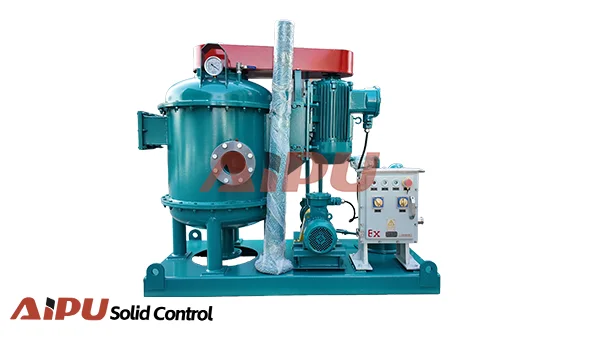
Gas entrainment in drilling fluid is a silent threat. It reduces mud density, damages pumps, and creates dangerous working conditions. The most effective tool to eliminate this problem is the vacuum degasser. But how does it actually work? This article provides a complete, standalone explanation of the internal mechanics, fluid dynamics, and operational principles of a vacuum degasser. We will use AIPU Solid Control vacuum degassers as reference examples to illustrate the technology.
1. The Core Principle: Lower Pressure, Bigger Bubbles
To understand how a vacuum degasser works, you need to remember two basic physical laws:
-
Henry’s Law: The amount of gas dissolved in a liquid decreases when the pressure above the liquid decreases.
-
Bubble expansion: A small gas bubble in a liquid will expand significantly when the surrounding pressure drops.
A vacuum degasser creates a low‑pressure chamber (partial vacuum) inside a sealed vessel. When gas‑cut mud enters this chamber, dissolved gas comes out of solution, and existing small bubbles grow larger. The enlarged bubbles become buoyant and rise to the surface, where they are continuously sucked away by a vacuum pump. The result is clean, degassed mud ready for recirculation.
2. Major Components of a Vacuum Degasser
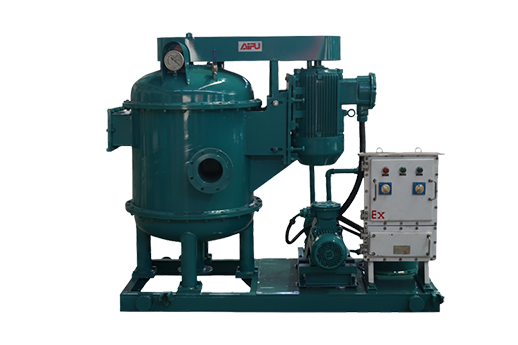
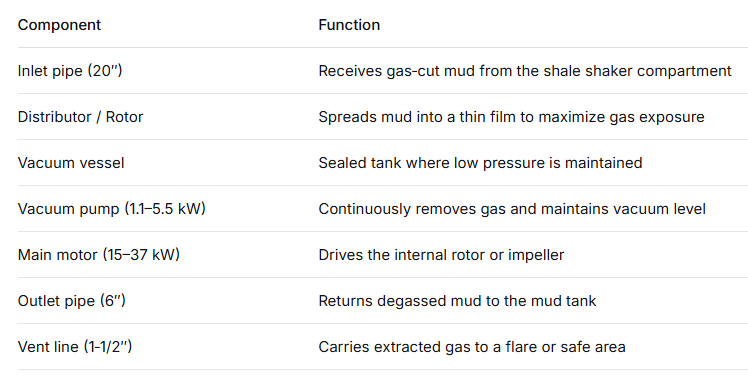
Before following the mud path, let us identify the key parts of a typical vacuum degasser (using the AIPU APLCQ300 vertical model as an example):
3. Step‑by‑Step Working Process
Now, let us follow a batch of gas‑cut mud as it passes through an AIPU vacuum degasser.
Step 1 – Mud Entry
Gas‑cut mud from the well flows over the shale shakers and enters the degasser through a large‑diameter inlet (e.g., 20 inches on the AIPU APLCQ300). The mud is directed onto a rotating distributor or a set of internal baffles.
Step 2 – Thin Film Formation
The distributor spins at high speed (driven by the main motor). Centrifugal force flings the mud outward against the vessel wall, creating a thin film that is only a few millimeters thick. This thin film exposes an enormous surface area – every gas bubble is brought close to the low‑pressure atmosphere.
Step 3 – Vacuum Application
The vacuum pump continuously draws gas out of the sealed vessel, maintaining a pressure of -0.02 to -0.04 MPa (gauge). This is well below atmospheric pressure. Under this vacuum, two things happen instantly:
-
Dissolved gas (gas that was molecularly dissolved in the liquid) comes out of solution – just like opening a soda bottle.
-
Entrained gas bubbles expand dramatically. A bubble that was 1 mm in diameter at atmospheric pressure can grow to 3–4 mm or larger.
Step 4 – Gas Separation and Removal
The expanded bubbles are now highly buoyant. They rise quickly through the thin mud film to the top of the vessel, where the vacuum pump continuously pulls them out through the vent line. For flammable or toxic gases (methane, H₂S), the vent line is connected to a flare ignitor (such as AIPU’s APFI series) for safe disposal.
Step 5 – Degassed Mud Discharge
Gas‑free mud falls to the bottom of the vessel and exits through a 6‑inch outlet. A centrifugal pump or simple gravity flow returns the cleaned mud to the mud tank, typically to the degasser compartment.
Step 6 – Continuous Circulation
This entire process is continuous. As long as the vacuum pump and the mud feed are running, the degasser removes gas from the mud stream without interruption.
4. Why Vacuum Degassers Are More Effective Than Atmospheric Degassers
Some older rigs use atmospheric degassers (baffle boxes) that rely only on gravity and gentle splashing. These units achieve only 70–85% gas removal. A vacuum degasser, by contrast, actively pulls gas out and expands bubbles under reduced pressure, achieving ≥95% efficiency. The difference is critical when drilling through gas‑bearing formations.
5. Types of Vacuum Degassers and Their Working Differences
Different designs achieve the same vacuum principle but with variations in how mud is distributed.
5.1 Centrifugal (Vertical) Degasser – Example: AIPU APLCQ300
-
How it works: A high‑speed rotor flings mud outward into a thin film. No internal baffles are needed.
-
Advantage: Very compact, no clogging, low maintenance.
5.2 Baffle (Tank‑Mounted) Degasser – Example: AIPU APZCQ Series
-
How it works: Mud flows by gravity over a series of horizontal or inclined baffles, creating multiple thin layers.
-
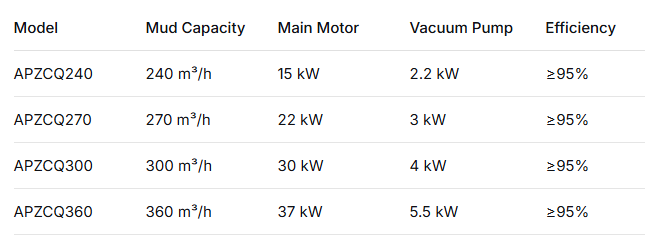
Advantage: High capacity (240–360 m³/h), no external feed pump required.
5.3 Float‑Controlled Degasser – Example: AIPU APVD Series
-
How it works: An internal float valve maintains a constant liquid level. Mud cascades gently over weirs, allowing gas to escape under vacuum.
-
Advantage: Low power consumption, automatic level control, energy‑efficient.
6. Technical Parameters – AIPU Vacuum Degassers
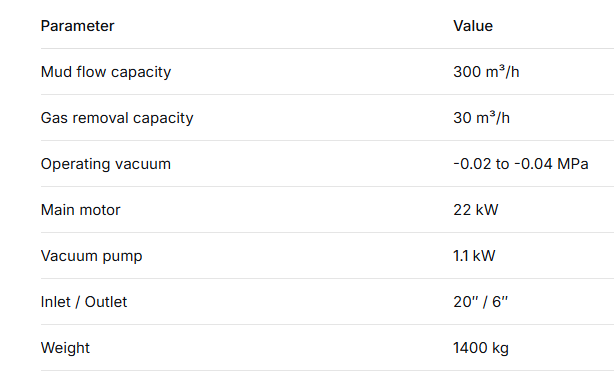
To understand how the numbers relate to performance, here are key specifications for AIPU models:
AIPU APLCQ300 (Vertical Centrifugal)
AIPU APZCQ Series (Tank‑Mounted)
All AIPU degassers are built with three‑layer marine anti‑corrosion coating, available with H₂S‑resistant steel (316L/2205), ATEX/IECEX certifications, and custom electrical systems (380V/50Hz, 460V/60Hz, etc.).
7. Installation Considerations for Proper Operation
Even a perfectly designed degasser will not work correctly if installed improperly. Follow these rules:
-
Place after shale shakers: Remove large solids first so they do not clog the degasser’s distributor.
-
Place before desanders/desilters: Gas removal improves hydrocyclone efficiency.
-
Ensure sufficient feed head: For gravity‑fed units, keep at least 0.5 m of mud above the inlet.
-
Keep vent line short and straight: Long vent lines create back pressure and reduce vacuum.
-
Do not block the outlet: The degassed mud must flow freely back to the mud tank.
8. Common Misconceptions About Vacuum Degasser Operation
❌ “A vacuum degasser can handle a gas kick.”
False. A gas kick produces large volumes of free gas that would overwhelm a vacuum degasser. Use a mud gas separator for kicks.
❌ “If I don’t see bubbles, the degasser isn’t working.”
Incorrect. Dissolved gas does not form visible bubbles until the pressure drops inside the degasser. The vacuum pump removing gas is a sign of normal operation.
❌ “Any vacuum level is fine.”
Not true. Too low a vacuum (e.g., -0.01 MPa) will not expand bubbles enough. Too high a vacuum (e.g., -0.08 MPa) may vaporize light hydrocarbons in oil‑based mud. AIPU degassers are designed for the optimal -0.02 to -0.04 MPa range.
9. Maintenance Tips to Keep Your Degasser Working Efficiently
-
Daily: Check vacuum level and listen for air leaks. Check vacuum pump oil level.
-
Weekly: Inspect the distributor or baffles for wear or solids build‑up. Clean as needed.
-
Monthly: Change vacuum pump oil. Check motor current and bearing temperature.
-
Annually: Open the vessel and inspect internal surfaces for corrosion. Replace worn seals.
10. How AIPU Vacuum Degassers Excel in Field Performance
AIPU Solid Control has over 20 years of experience in drilling fluid solids control. AIPU products have been delivered to more than 30 countries, with cumulative shipments exceeding 300 system‑equivalent units. AIPU holds API certifications, HSE certifications, and multiple independent patents.
When you choose an AIPU vacuum degasser, you get:
-
≥95% gas removal efficiency, restoring mud density quickly.
-
Rugged construction with sand‑blasted, three‑layer marine coating.
-
Proven performance in water‑based, oil‑based, and synthetic‑based muds.
-
Full customization for sour gas (H₂S‑resistant steel) and hazardous areas (ATEX/IECEX).
11. Conclusion
So, how does a vacuum degasser work? It applies a partial vacuum to drilling fluid, which causes dissolved gas to come out of solution and entrained bubbles to expand dramatically. The enlarged bubbles rise to the surface and are continuously removed by a vacuum pump. The result is clean, degassed mud that maintains proper density, protects mud pumps, and ensures a safe drilling environment.
Whether you need a compact vertical unit (AIPU APLCQ300), a high‑capacity tank‑mounted degasser (AIPU APZCQ series), or an energy‑efficient float‑controlled model (AIPU APVD series), AIPU has the right solution for your rig.
Make gas removal simple, reliable, and effective – choose AIPU vacuum degassers.
Related Products